
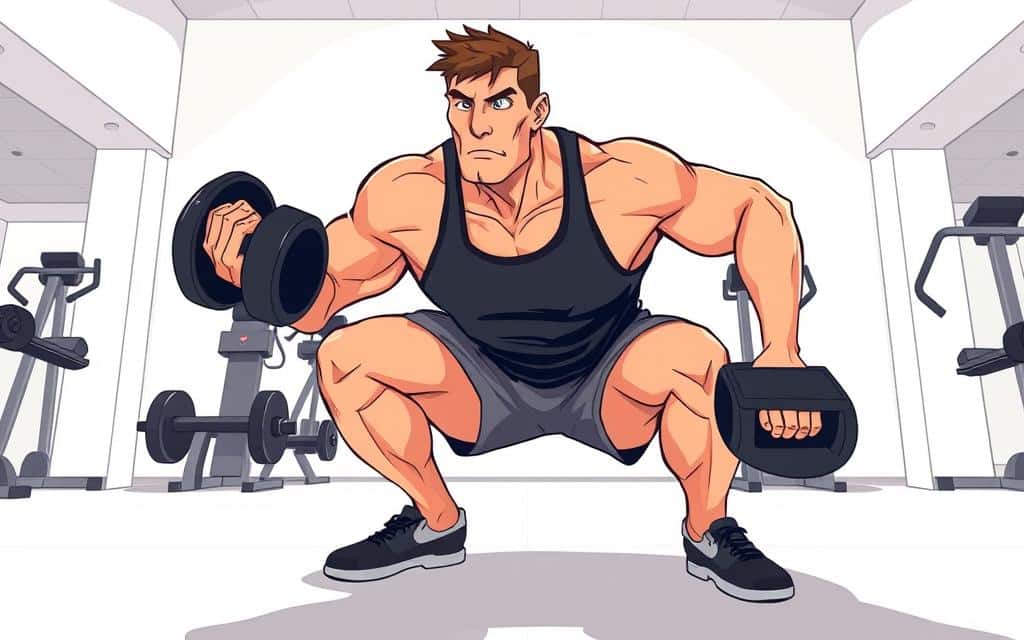
You can build real strength at home with a simple leg day dumbbell only workout that targets quads, glutes, and hamstrings without a gym. Picture the click of plates, steady breath, and slow control as you level up every set.
This plan gives clear, coach-style direction: which exercises to pick, how to cue form, and how to progress by adding small weight increments. You’ll get a practical flow—push, hinge, lunge, and calf—so each session feels organized and efficient.
Expect warm-ups and cool-downs that protect your joints, options to fix imbalances with unilateral work, and simple rules for choosing light, medium, and heavy dumbbells. By the end, you’ll have a repeatable system to train your lower body, build strength, and improve balance with minimal space and fuss.
Key Takeaways
- You’ll learn a full plan using just dumbbells: exercises, sets, reps, and progressions.
- Warm-ups and cool-downs are included to protect knees and hips.
- Unilateral options help fix imbalances and boost stability.
- Small weight jumps (2–5 lb) keep progress consistent and safe.
- The session follows a push-hinge-lunge-calf flow for efficiency.
Why train legs with dumbbells for serious lower body results
Training your lower body with free weights gives you a practical, joint-friendly path to strength. You get a natural range motion that usually feels better on hips, knees, and ankles than fixed machines or a locked barbell position.
More natural range of motion and joint-friendly movement
Hand-held weights let your arms and hips find a comfortable line. That reduces strain on the lower back and helps you load muscles without forcing an awkward posture.
Unilateral work to fix imbalances and improve balance
Training one side at a time exposes side-to-side differences. Single-sided movements build control, recruit stabilizers, and translate into better squats and cleaner stepping patterns.
Big variety, small space, cost-effective setup at home
With a pair of dumbbells you can hit squats, hinges, lunges, step-ups, hip drives, and calf moves. That variety supports muscle, endurance, and functional movement for daily life.
- Practical outcome: Fix asymmetries and boost stability.
- Simple to progress: Add small weight jumps to build strength.
- Beginner-friendly: Easier to learn and safer than larger bars.
| Benefit | Why it matters | Result you’ll feel |
|---|---|---|
| Natural joint path | Movements are not locked into a machine track | Less knee and back irritation |
| Unilateral training | Targets one side at a time to find weakness | Better balance and stronger single-leg power |
| Versatility | Many exercises from a compact set | Full body strength and functional gains |
| Affordable setup | Minimal space, low cost | Consistency that builds real progress |
Your leg day dumbbell only workout at a glance
This quick blueprint shows which movements to do, when, and how to hold the weights. Use a simple kit and a tight flow so you spend less time guessing and more time getting stronger.
What you need: light, medium, and heavy dumbbells
Grab three sets if you can: light for warm-ups and finishers, medium for accessory work, and heavy for your main sets. Pick a weight where the last two reps feel hard but clean.
How to structure the session: push, hinge, lunge, calf
- Start stance: stand feet hip-width apart and brace your core.
- Push (squat): hold at shoulder height or goblet for posture and quad demand.
- Hinge: hinge with “hips back, chest long” and keep the dumbbell hand close to your legs.
- Lunge/split: set your position tall, step with intent so the front shin stays vertical.
- Calves: slow reps with a hard squeeze at the top finish the session.
| Phase | Typical sets | Goal |
|---|---|---|
| Push (squat) | 3–5 | Strength & posture |
| Hinge | 3–4 | Posterior chain |
| Unilateral | 2–4 | Balance & symmetry |
| Calf | 2–3 | Finish with control |
Keep rest 60–120 seconds unless you go heavy. If short on time, run the push-hinge-lunge as a circuit and cap with a brisk calf finisher. Use the correct position and weight to make each set count.
The best dumbbell leg exercises to build strength and muscle
These targeted exercises build strength and muscle with clear cues so you feel the right muscles working each set. Use them as your core menu and pick 4–6 moves per session.
Goblet squats — quad strength and upright posture
Why it works: Loads the front chain while forcing an upright torso for clean squats.
- Cue: chest and elbows up, core braced.
- Cue: knees track with toes; sit between the knees on the descent.
Dumbbell front squat — heavier loading at shoulder height
Why it works: Lets you load more at shoulder height for stronger quads and a tougher core demand.
- Cue: rack at shoulder height, elbows slightly forward.
- Cue: ribs stacked, drive through mid-foot.
Dumbbell Romanian deadlift — hamstrings and glutes
Why it works: A hip hinge that targets hamstrings and glutes without spine rounding.
- Cue: push hips back, slide weights to mid-shin.
- Cue: keep back straight, finish by driving hips forward.
| Move | Primary target | Key cue |
|---|---|---|
| Bulgarian split | Quads & glutes | Bench ~knee height, hips square |
| Single-leg deadlift | Posterior chain & balance | Hips square, reach toward standing foot |
| Step-up / Hip thrust / Calf raise | Single-leg power / glute peak / lower leg | Whole foot on box; drive through heels; slow squeeze |
Form cues that protect your lower back and boost results
Before you add weight, lock a few reliable cues into place so each rep counts. These simple habits keep your spine safe and make every set more effective.
Stand feet hip-width apart and brace your core
Start most lifts with your stand feet set hip-width apart. Spread through the toes and brace your core like someone will tap your stomach.
Hinge from the hips, not the spine
For RDLs and hinges, push your hips back and keep your back long. Drive the hips until your back would round, then stop. This shifts load into hamstrings, not your lower back.
Knees track with toes—no caving or flaring
Let toes point slightly out, and make sure knees follow that line. Avoid collapse or splaying to protect ligaments and improve force transfer.
Control the full range of motion on every rep
Use a steady tempo—own the lowering phase, pause if needed, then drive up without bouncing. Build range motion gradually; depth should feel controlled, not forced.
- Keep the dumbbell hand path close on hinges to keep tension where you want it.
- Stack your position: shoulders down, ribs over hips, and head neutral.
- On split moves, stay tall and set stride so the front shin stays near vertical.
| Cue | Why it matters | Quick fix |
|---|---|---|
| Brace core | Protects the back under load | Exhale and tighten before each rep |
| Hinge at hips | Loads hamstrings, spares spine | Push butt back, keep chest long |
| Knees aligned | Improves force transfer | Track knees with toes during descent |
| Controlled tempo | Maximizes muscle work and safety | Slow down the lowering phase |
Keep these cues front of mind and you’ll get more from each dumbbell exercise while protecting your back and building real strength.
Warm-up and cool down for better performance and recovery
Start your session by waking up the hips, ankles, and core with a short, dynamic circuit that primes movement. This prepares the body so you lift with more control and less risk.
Quick dynamic warm-up
Do 1–2 rounds: bodyweight squat x12, alternating curtsy lunge x12, alternating side lunge x12. Move smooth and keep full-body tension so your muscles and balance systems engage.
- Bodyweight squat x12: sit tall, drive knees over toes, feel the quads and glutes fire.
- Alternating curtsy lunge x12: step behind at a comfortable angle to warm glutes without pinching the knee.
- Alternating side lunge x12: step wide, sink into the hip, keep the other leg straight to open inner thighs.
Post-workout cool down
Finish with these holds to speed recovery and loosen tight areas after loaded sets.
- Hip flexor stretch: 30s per side — tuck the tail and press hip forward.
- Lying figure-4: 30s per side — targets deep glutes and eases lunge tightness.
- Butterfly: 30s — sit tall and open the groin with a long spine.
- Downward dog + calf pedal: 30s — alternate heel drops to massage the calves and feet.
| Phase | Duration / Reps | Main benefit |
|---|---|---|
| Warm-up circuit | 1–2 rounds; 12 reps each | Increase blood flow, prime muscles and balance |
| Cool-down sequence | 30s holds each | Reduce stiffness, promote recovery, restore range of motion |
| Short option | 1 warm-up round + 1 cool-down cycle | Fast prep and recovery when time is tight |
Pro tip: Keep warm-up reps steady and stop when you feel ready to lift. If you plan to grab dumbbells, aim for a slight sweat so the tempo of the session stays crisp.
Programming your dumbbell leg workouts: sets, reps, and progression
Smart programming turns limited gear into steady gains you can track week to week. Start by picking a weight that makes the last two or three reps challenging but clean. If form breaks, drop load or shorten the range until you can control each rep.
Choose the right weight
Pick a weight you can lift for your target reps with good form. The final reps should feel hard, not sloppy. If sets feel easy for a week, add 2–5 lb.
Set and rep targets
- Strength: 4–6 sets of 4–6 reps, 2–3 minutes rest.
- Hypertrophy: 3–4 sets of 6–12 reps, 60–120 seconds rest, slow eccentrics.
- Endurance/conditioning: 2–4 sets of 12–20 reps or 30–60s timed sets.
Progressive overload and tempo
When you can complete all sets with a buffer, increase weight by 2–5 lb or cut rest by 15–30 seconds if heavier plates aren’t available. Use tempo to raise demand — try a 3-1-1 cadence (3s down, 1s pause, 1s up).
| Goal | Sets | Reps |
|---|---|---|
| Strength | 4–6 | 4–6 |
| Hypertrophy | 3–4 | 6–12 |
| Endurance | 2–4 | 12–20 or timed |
Practical rules: prioritize full range of motion, keep the spine braced, and log sets, reps, weight, and rest. Aim for 1–2 sessions per week, spaced 48–72 hours apart, and swap in single-leg options if your back feels taxed.
Sample dumbbell-only leg day templates you can follow today
These ready-to-run templates take guesswork out of training and fit tight schedules or small spaces.
Strength focus: hinge + squat + unilateral finisher
Plan:
- Dumbbell RDL — 5×5 (2–3 min rest)
- Dumbbell Front Squat — 5×4–6 (2–3 min)
- Bulgarian Split Squat — 3×6/side (90–120 sec)
Cues: keep the bells close on RDLs, brace hard on front squats, and lean slightly forward on splits to drive the glutes and hamstrings.
Hypertrophy focus: squats, lunges, thrusts, and calf work
- Goblet Squat — 4×8–12
- Walking Lunge — 3×10–12/side
- Hip Thrust (bench) — 4×10–15 (pause & squeeze)
- Standing Calf Raise — 3×12–20
Cues: hit depth on squats, control steps on lunges, place full foot on the bench for step-ups and thrusts.
At-home conditioning circuit with minimal space
3–5 rounds: 45s Goblet Squat, 45s Alternating Lunges, 45s Step-Ups (switch lead), 45s RDL. Rest 60–90s.
Tip: keep your chest up, choose a load you can move cleanly, and use a bench or low box. If no bench, swap floor glute bridges and low step-ups.
| Template | Sets / Reps | Rest / Goal |
|---|---|---|
| Strength | 5×5; 5×4–6; 3×6/side | 2–3 min; heavy, powerful reps |
| Hypertrophy | 4×8–12; 3×10–12/side; 4×10–15; 3×12–20 | 60–90s; controlled tempo, big squeezes |
| Conditioning | 3–5 rounds; 45s work per station | 60–90s rest; maintain form under fatigue |
Common mistakes in dumbbell leg exercises and how to fix them
Tiny faults in position or depth can rob you of strength and safety. Below are clear mistakes, quick fixes, and a single cue you can use on the next set.
Partial reps that cut range of motion short
Mistake: shallow reps that limit range motion and reduce stimulus.
Fix: lower the weight and use a bench as a depth guide. Cue: “sit a bit deeper, control up.”
Knees collapsing or pushing out of alignment
Mistake: knees cave or flare and strain joints.
Fix: spread the floor with your feet and keep arches active. Cue: “drive knees out to follow toes.”
Lunge stride and torso position errors
Mistake: stride too long or short, or torso tipping forward.
Fix: aim for ~90° at both knees and stack ribs over hips. Cue: “shorten step, stand tall.”
RDLs turning into back rounds instead of hip hinges
Mistake: hinge becomes a back bend and you feel it in the lower back.
Fix: hinge at the hips, keep dumbbell romanian form with bells close to legs and stop before rounding. Cue: “hips back, chest long, feel hamstrings.”
| Issue | Quick fix | Try this cue |
|---|---|---|
| Partial reps | Reduce load; use bench | “Sit deeper, control up” |
| Knee collapse | Activate arches; spread toes | “Drive knees out” |
| One-leg wobble | Light support from wall | “Touch and release” |
| Foot on step | Plant whole foot; push through heel | “Full foot, squeeze” |
Conclusion
Pick a template and start today. Choose one plan, set your dumbbell load, and focus on solid position from the first rep. Stand feet solid, brace the core, and move with control so the back, knees, and glutes stay protected.
Keep goblet squats, RDLs, lunges, and the Bulgarian split in rotation. Plant your whole foot on step-ups, secure the bench for thrusts, and use the dumbbell hand path that feels tight to the body.
Progress by 2–5 lb or trim rest if plates are capped. Track sets, reps, and weight so you know what to level up next. Now pick a plan, grab the weights, and get after it—stronger lower body starts today.