Beginner’s Guide to Body Recomposition: Sculpt Muscle, Lose Fat
Published
Have you ever felt stuck choosing between losing fat and gaining muscle? What if you could do both at the same time? If you’re starting out to reshape your physique, a structured beginner body recomposition workout plan gives you a clear path to getting stronger.
With the right approach, your body can change in amazing ways.
I want to help you understand that achieving a lean, muscular shape is entirely within reach. We’ll explore how to shift your composition by simultaneously torching fat and adding quality tissue. This method is far more sustainable than the old cycle of brutal cutting and bulking.
My goal is to simplify the science so you can stop guessing and start seeing real changes. You might feel overwhelmed by all the fitness noise, but together we’ll cut through it. We’ll focus on what actually works, whether you’re new to the gym or refining your approach, like with a solid strength training routine for over 40s.
I’ve seen many people make real progress by committing to this process. I’m excited to guide you every step of the way. Let’s grab this opportunity to build a stronger you.
Key Takeaways
- Body recomposition allows you to lose fat and build muscle simultaneously, a process backed by modern exercise science.
- This approach is more sustainable and effective than traditional cycles of cutting and bulking.
- A structured plan provides a clear roadmap, eliminating guesswork and confusion.
- The principles are adaptable, whether you’re just starting out or are an experienced fitness enthusiast.
- Focusing on consistent, progressive training and proper nutrition is the core of successful recomposition.
- It’s a process that builds not just physical strength, but also confidence and long-term health.
- You are not alone, guidance and support can make all the difference in achieving your goals.
Understanding Body Recomposition
Your body is capable of remarkable change, and you don’t have to pick one goal over the other. This smarter path is all about shifting your ratios for a stronger, leaner you.
What Is Body Recomposition?
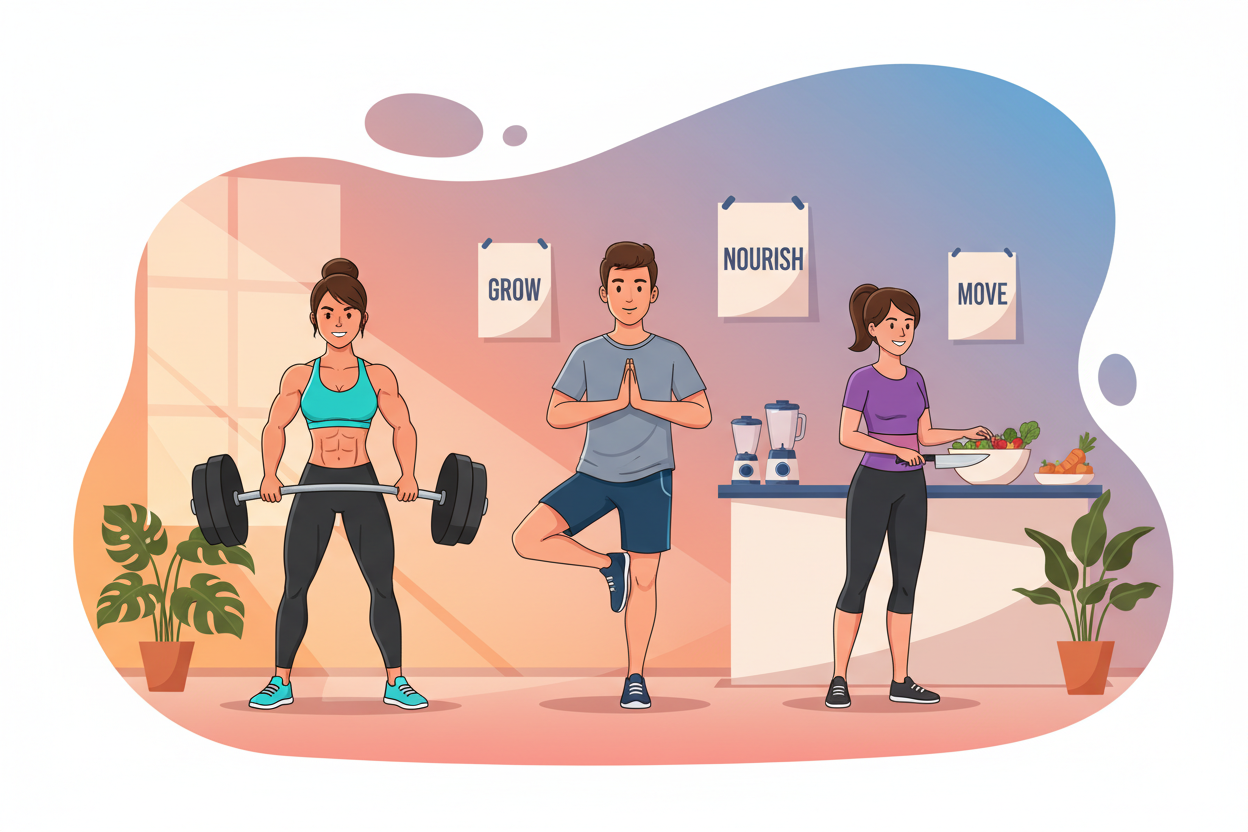
Simply put, it’s the process of altering your physical makeup by losing fat and gaining lean tissue simultaneously. I love that science backs this up! Building muscle costs fewer calories than most people think.
This means your system can often fuel new growth from stored fat. Your total weight on the scale might stay steady for a while, but your physique changes.
Distinguishing Between Recomposition and Traditional Cutting/Bulking
The old method is a rigid cycle. You bulk up (gain muscle and fat), then cut down (lose fat and some muscle). It’s a rollercoaster. Recomposition treats energy balance as a flexible continuum.
We’re balancing a see-saw. We prioritize feeding muscle growth while creating a slight deficit to tap into fat stores. The result is steady, sustainable progress over time.
| Aspect | Body Recomposition | Traditional Cut/Bulk |
|---|---|---|
| Primary Goal | Lose fat & gain muscle concurrently | Cycle between one goal at a time |
| Energy Balance | Managed continuum; slight deficit or maintenance | Sharp surplus (bulk) or large deficit (cut) |
| Scale Weight Trend | Often stable; body composition changes | Significant increases and decreases |
| Overall Strategy | Consistent, integrated nutrition & training | Distinct, separate phases with different focuses |
This integrated approach is less stressful on your mind and your metabolism. You get to see changes in the mirror long before the scale might budge.
Benefits of Shifting Your Body Composition
The real key of fitness happens when you prioritize what your body is made of, not just what it weighs. I’ve learned this shift is about health first, aesthetics follow.
That stubborn belly fat isn’t just superficial. Visceral fat crowds your organs and hampers their function. Reducing it is a huge win for your long-term wellness.
Here’s another win: building lean muscle mass naturally fires up your metabolism. You’ll burn more calories around the clock, even while resting! This creates a fantastic cycle of support for your goals.
Prioritizing muscle also protects you from health issues linked to a larger waistline. I’ve found focusing on composition keeps motivation high. The scale might stall, but your clothes fit better.
We’re building a resilient frame that performs. It’s not just about a mirror snapshot. It’s about creating a physique that supports a vibrant, active life for years to come.
Foundation: Nutrition and Macronutrients
I used to believe training was everything, until I learned that nutrition is the true engine of physical change. What you eat directly fuels your ability to change your body.
Balancing Protein, Carbs, and Healthy Fats
Your focus should be on protein. Aim for 1.6 to 2.2 grams per kilogram of your weight daily. This supports vital tissue repair and growth.
A smart macro split works wonders. Try 30-35% of your calories from carbs, the same from protein, and 30-40% from healthy fats. Carbs are not the enemy, they spare protein and fuel your sessions.
Fats support hormone function and keep you full. This balance gives your system the energy it needs to perform and recover.
Implementing Calorie Cycling for Sustainable Progress
Calorie cycling is a big help. You eat more on hard training days to support growth. On rest days, you consume less to encourage fat utilization.
This flexible approach prevents metabolic slowdown. It aligns your intake with your actual energy needs each day.
| Day Type | Calorie Intake | Protein Focus | Primary Goal |
|---|---|---|---|
| Training Day | Higher (Maintenance or Slight Surplus) | High (≥2g/kg) | Support Muscle Growth & Performance |
| Rest Day | Lower (Slight Deficit) | High (≥1.6g/kg) | Promote Fat Loss & Recovery |
By managing your intake this way, you provide the precise building blocks for change. Consistency with this strategy leads to steady, visible results.
Perfecting Your Calorie Deficit Approach
I want to share a simple truth: a smart calorie deficit changes everything about your physique. It’s the lever you pull to tell your system to use stored energy.
To lose fat, you need a modest shortage of calories. Remember, one pound of fat holds about 3,500 calories. That’s a lot of energy!
I like to picture one pound of fat as 1.2 pounds of skinless chicken breast. It helps me see the actual tissue we’re aiming to lose.
Your starting point dictates your pace. People with more fat to lose can drop weight faster. A lean athlete needs a tiny, precise deficit.
| Starting Point | Body Fat % | Safe Weekly Fat Loss | Primary Focus |
|---|---|---|---|
| Higher Weight Individual | ~30% or more | 2-3 pounds | Create a consistent deficit |
| Lean Athlete | ~15% or less | 0.5-1 pound | Preserve muscle mass |
Go too sharp with your deficit, and you risk losing hard-earned muscle. We must protect that precious tissue.
Consistency is king. A moderate calorie shortage lets your body tap into fat stores. You’ll still have plenty of energy to train hard and build strength.
Designing Your Resistance Training Framework
I learned the hard way that random workouts don’t build lasting strength. To see real change, you need a smart, structured plan. This framework is your blueprint for building an effective, resilient physique.
Embracing Progressive Overload Strategies
The core principle is progressive overload. You must consistently challenge your muscles by adding a little more weight or doing more reps over time.
This is the primary driver for muscle growth. This consistent signal tells your system to prioritize building new tissue.
Mapping Out Weight Lifting Techniques for Strength Gains
Focus on compound exercises like squats and deadlifts. They work multiple muscle groups at once, giving you the best return on your effort.
Aim to hit each major group twice weekly. This frequency optimizes your gains. Even when eating in a slight deficit, your goal is to get stronger.
Add weight to the bar whenever you can while keeping perfect form. This is how you build real, functional strength.
Integrating Cardio for Optimal Fat Loss
Many people think cardio will ruin their gains, but I’ve found the opposite is true with the right approach. We integrate it carefully to boost fat loss without slowing down muscle recovery.
It’s all about balance. I use a mix of Low-Intensity Steady State (LISS) and High-Intensity Interval Training (HIIT). This keeps our metabolic conditioning high.
Comparing HIIT and LISS for Cardiovascular Conditioning
For LISS, I recommend 30 to 45 minutes of brisk walking or cycling. Keep your heart rate between 64% and 76% of your maximum. This is the sweet spot for moderate effort.
HIIT is incredibly time-efficient. A simple protocol is 20 seconds of all-out effort on an air bike, followed by 40 seconds of slow recovery. You get a huge metabolic boost in a short session.
| Type | Intensity | Duration | Primary Benefit | Best For |
|---|---|---|---|---|
| HIIT | Very High to Low (Intervals) | 10-20 minutes | Maximizes calorie burn & metabolic rate | Time-crunched days |
| LISS | Moderate (64-76% Max HR) | 30-45 minutes | Promotes fat utilization & active recovery | Rest days or post-lifting |
Avoid spending hours on the elliptical. Excessive cardio can hinder your ability to build muscle and recover from your primary training sessions.
By balancing these two types, we ensure our physique has the energy to tackle our main lifting exercises. This strategic integration makes all the difference.
Tracking Progress with Clinical Tools and DEXA Scans
Tracking your progress is about more than just a number on a scale, it’s about understanding the real changes happening inside your physique. I learned this the hard way. My bathroom scale told me one story, but my reflection and how my clothes fit told another.
That confusion ends with precise, clinical-grade data. Tools like DEXA scans move us beyond guesswork into the realm of measurable progress.
Benefits of Using BodySpec DEXA Scans
I recommend BodySpec DEXA scans because they give you the complete picture in under 10 minutes. You get a detailed breakdown of your bone mass, lean tissue, and fat mass. This is the gold standard for accuracy.
| Metric | Standard Bathroom Scale | BodySpec DEXA Scan |
|---|---|---|
| Data Provided | Total weight only | Bone, muscle, & fat mass; visceral fat; limb balance |
| Time for Analysis | Instant | Less than 10 minutes |
| Accuracy for Change | Misleading | Clinical-grade precision |
These scans reveal exactly how much lean muscle you’ve gained and fat you’ve lost. They even spot imbalances between your left and right sides.
You can track dangerous visceral fat levels, proving your internal health is improving. This objective data fuels motivation, especially when the scale weight stays the same. Seeing concrete results makes the entire process worthwhile.
Your Beginner Body Recomposition Workout Plan
Let’s dive into the actionable blueprint that will turn your fitness goals into reality. I’ve crafted this 8-week schedule to be your roadmap. It’s split into two distinct phases for steady, smart progress.
The routine uses an upper/lower split format. This means we target every major muscle group twice each week. That frequency is perfect for building new tissue and allowing proper recovery.
Phase 1 is all about building a solid foundation. We focus on mastering movement patterns and establishing a strength baseline. Perfecting your form here prevents injury and sets you up for success.
Phase 2 introduces new intensity techniques to push your limits. The entire plan is designed for sustainability. You can follow this structure for months to see steady physical changes.
| Aspect | Phase 1: Foundation (Weeks 1-4) | Phase 2: Intensification (Weeks 5-8) |
|---|---|---|
| Primary Focus | Master form & establish baseline strength | Apply intensity techniques & progressive overload |
| Training Frequency | 4 days per week (Upper/Lower split) | 4 days per week (Upper/Lower split) |
| Key Emphasis | Learning movement patterns, mind-muscle connection | Adding weight, advanced sets (e.g., drop sets) |
| Progression Goal | Consistent technique across all exercises | Increase strength output in each session |
Every session is efficient. You’ll get in, tackle your exercises, and get on with your day knowing you made real progress. This is how we build a stronger, leaner you.
Advanced Techniques: Supersets, AMRAPs, and Intensity Methods
Advanced intensity methods like supersets and AMRAPs help break through frustrating plateaus. I love using these methods to stimulate new growth when progress stalls.
Let’s define AMRAP first. It stands for “As Many Reps As Possible.” You use it on your final set to push your muscle closer to failure. This ensures you’re truly challenging your physique for maximum gains.
Supersets are my go-to for busy days. You perform two exercises back-to-back with little rest. This increases the density of your training and keeps your heart rate up.
Both methods are fantastic for breaking through stagnation. Remember, they supplement your primary lifts. Keep your form tight, even when pushing for that last rep.
| Technique | Primary Benefit | How to Implement | Best Used For |
|---|---|---|---|
| Supersets | Increase density & save time | Perform two exercises back-to-back with minimal rest | Finishing a muscle group or time-crunched sessions |
| AMRAP Sets | Push to failure for maximum stimulus | Do as many reps as possible on the final set | Breaking strength plateaus on key lifts |
Integrate these methods in the later weeks of your program. They add an effective new stimulus that your body must adapt to. This is how you keep making progress month after month.
Strategic Meal Timing and Frequency for Maximum Impact
Strategic meal timing isn’t about rigid rules; it’s about optimizing your body’s natural processes. I used to stress over eating every few hours. Now, I focus on hitting my total targets for the day.
Aim to consume 20-40 grams of high-quality protein per meal to support muscle protein synthesis. This keeps your body in a growth-friendly state. I aim for this range with each meal to support repair and development.
Time your carbohydrate intake around your training sessions. Eat more carbs before and after to fuel performance and speed up recovery. This simple shift makes a huge difference in energy levels.
Consistency across your days is far more important than micromanaging every snack. Focus on hitting your protein and calorie goals over the entire week. Building sustainable daily habits that boost muscle growth and is the real key.
| Approach | Protein per Meal | Meal Frequency | Primary Goal |
|---|---|---|---|
| Traditional Frequent Eating | Variable, often lower | 6+ small meals per day | Stoke metabolism (myth) |
| Strategic Protein Timing | 20-40 grams | 3-4 meals per day | Maximize muscle protein synthesis |
By spreading your protein evenly, you give your muscles a steady supply of building blocks. Your body can then repair and grow stronger after every session. Hit your numbers for the day, and let the results follow.
Addressing Common Plateaus in Your Training
Plateaus are a natural part of any fitness routine, not a sign of failure. I’ve hit them many times myself. It’s just your physique adapting to your current routine.
When progress stalls, a strategic carb refeed can work wonders. Temporarily increasing your calories from carbohydrates helps revive your metabolism. It also fuels more intense sessions.
Overcoming Weight Loss and Muscle Gain Plateaus
Sometimes your calorie deficit needs a tweak. As you get leaner, your system requires less energy. A small adjustment can restart fat loss.
Don’t fixate on the scale. Focus on strength gains instead. Lifting more weight is a clear sign your muscle is growing, even if the number doesn’t move.
| Plateau Type | Common Sign | Primary Strategy | Key Adjustment |
|---|---|---|---|
| Weight Loss | Scale weight stalls for 2+ weeks | Strategic carb refeed or slight deficit reduction | Increase calories by 10-15% for 1-2 days |
| Muscle Gain | Strength progress halts | Increase training intensity or calorie surplus | Add 100-200 daily calories, focus on protein |
Stay patient. We overcome these hurdles with small, smart tweaks, not extreme measures. Trust the process.
Staying Consistent: Motivation, Rest, and Recovery
Sunday is my sacred day for complete restoration, and it’s the most important appointment on my weekly calendar. In our 8-week schedule, it’s a full rest day. This allows for total muscle recovery and nervous system reset. Let’s be honest, consistency isn’t just about the grind. It’s about balancing intense effort with dedicated renewal.
Nurturing Your Mindset and Recovery Practices
Sleep and stress management are the unsung heroes here. They directly impact your body‘s ability to repair itself. Good sleep regulates hormones that support growth. Managing stress keeps cortisol in check.
Nurturing a positive mindset is key on tough days. Be kind to yourself. Remember, every single day of effort moves you forward. This is a long-term process we’re on together.
| Aspect | Active Recovery Day | Complete Rest Day (e.g., Sunday) |
|---|---|---|
| Primary Goal | Promote blood flow & reduce soreness | Full physical & mental restoration |
| Activity Level | Light walking, stretching, yoga | No structured exercise; true rest |
| Benefit for Consistency | Keeps momentum without strain | Prevents burnout, recharges motivation |
| Impact on Next Session | May improve readiness | Ensures peak energy and focus |
By prioritizing these recovery practices, you build resilience. You’ll show up to your next training session energized and ready to perform. That’s how we build lasting consistency.
Conclusion
This process reshapes more than your physique, it builds a foundation of strength that lasts. We’ve walked through the essential pillars together: smart nutrition, effective training, and precise tracking.
Remember, changing your body composition is a marathon. It requires patience, consistency, and a willingness to tweak your approach as you see results. Celebrate every pound of fat lost and every new personal record.
You now have the knowledge to set your calorie goals, structure your sessions, and fuel your body for the change you want. Stay locked on your long-term goal, and trust the daily process.
I’m excited for you. Grab your gear and start building the stronger, healthier version you deserve. Every rep and every healthy meal adds up. Let’s go build that effective body and resilient muscle!
FAQ
What exactly is body recomposition?
It’s the amazing process of changing your body’s makeup by losing fat and building lean muscle at the same time. Instead of just watching the scale, you’re changing how you look and feel, sculpting a stronger, more defined physique.
How is this different from just cutting or bulking?
Traditional bulking and cutting are separate phases. You either eat in a surplus to gain size (and some fat) or in a deficit to lose weight (and some muscle). Recomposition aims for the best of both worlds simultaneously, which is fantastic for sustainable, long-term change.
Is high protein really that important?
Absolutely! Protein is the building block for your muscles, especially when you’re training hard. It helps repair tissue and keeps you feeling full. I aim for a solid intake daily, it’s a non-negotiable for supporting strength gains and recovery.
What’s the best type of cardio for fat loss?
Both HIIT and steady-state (LISS) have their place! I love HIIT for its efficiency and metabolism boost. But don’t sleep on a brisk walk or bike ride, LISS is easier on your joints and aids recovery. A mix of both often works wonders.
How do I know if my program is actually working?
Ditch the scale as your only metric! Take progress photos, notice how your clothes fit, and track your strength in the gym, like adding more weight or reps. For precise data, I use a BodySpec DEXA scan to see my exact muscle and fat changes.
I’m stuck in a plateau. What should I do?
First, don’t get discouraged, plateaus happen to everyone! Take a look at your nutrition and training. Sometimes you need to adjust your calories slightly, change up your exercise selection, or prioritize sleep. A small tweak can restart your progress.
How many days a week should I train?
For most people starting out, 3-4 days of focused resistance training is perfect. This gives you enough stimulus to build strength while allowing crucial time for your muscles to recover and grow. Consistency with this schedule beats sporadic, grueling sessions.
Can I still see results without a gym membership?
100%! You can achieve incredible results at home with bodyweight exercises, resistance bands, or a few dumbbells. The key principles are the same: challenge your muscles with progressive overload and pair it with smart nutrition. Your living room can be your gym!