
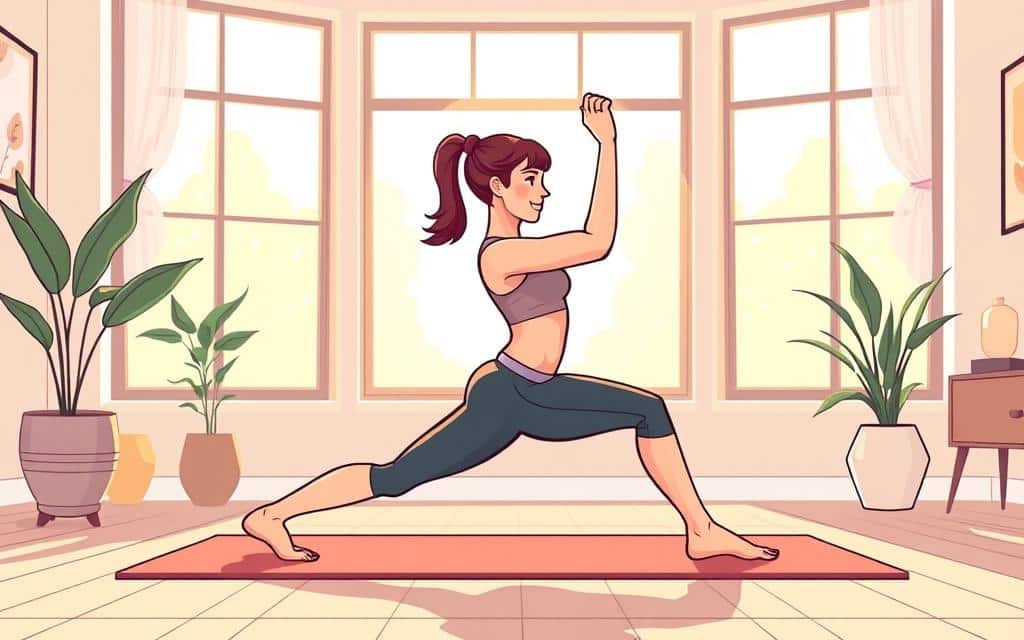
Start strong: the beginner glute workout at home wakes up your hips with moves you can feel in minutes, not hours. Picture firm, steady steps and a more upright posture when you sit, stand, or lift your kid off the couch.
Strong glutes improve posture, balance pelvic alignment, and cut strain on the lower back. Bodyweight exercises like squats, bridges, lunges, and single-leg RDLs build real strength without gear.
Use short circuits, Tabata rounds, or simple supersets to save time and keep sessions focused. A mini-band boosts abductor activation when placed above the knees or at the ankles.
Warm up to raise temperature and mobilize hips and hamstrings. Finish with hamstring, piriformis, and hip flexor stretches so your lower back stays happy. Form comes first: aligned feet, braced core, and smooth control beat rushing any day.
Key Takeaways
- Set clear goals: learn stable movement and feel the right muscles engage.
- Bodyweight moves (squats, bridges, lunges) build useful strength.
- Circuits, Tabata, and supersets make training time-efficient.
- Mini-bands increase side muscle work when placed above knees or ankles.
- Warm-ups and targeted stretches protect your lower back and improve mobility.
What you’ll get from this beginner glute workout at home
Expect measurable strength gains, smarter movement, and less strain on your lower back.
Strong glutes stabilize the pelvis so your hips and spine share the load. That means everyday tasks feel easier and your muscles work together instead of one area overcompensating.
- Better hip and pelvic control to protect your lower back during daily movement.
- Noticeable strength in carrying, climbing, and standing as your legs and core share effort.
- Improved balance and single-leg stability for cleaner lunges and smoother running mechanics.
- Faster results from short, focused sessions like circuits and intervals that build size and power.
- Clear mind-muscle connection so you feel the right muscles engage each rep.
| Outcome | Time per session | Who benefits |
|---|---|---|
| Reduced low-back strain | 10–20 minutes | Anyone with desk time |
| More daily power | 15–25 minutes | Busy adults and athletes |
| Better balance & stability | 10–15 minutes | Runners and hikers |
| Scalable strength plan | Any session length | All fitness levels |
Know your glute muscles before you train
Understanding which muscles do the work makes every rep more effective. That clarity helps you pick the right move for a specific problem, not just random effort.
Gluteus maximus: hip extension power and shape
The gluteus maximus is the big power driver for standing, sprinting, and climbing stairs. It creates hip extension and gives much of the rear shape you see in the mirror.
Train it with bridges, hip thrusts, squats, and hinge patterns to build both shape and drive. For pure burnout, add paused top holds or slow eccentrics to tax the muscle.
Gluteus medius and minimus: pelvic stability and side-to-side control
The gluteus medius (with the minimus underneath) sits high on the side of the hips. These smaller muscles keep your pelvis level on one leg and control thigh rotation.
When medius is weak, knees cave and hips wobble. Use band walks, clamshells, and lateral moves to fix that. Strong stabilizers soak up ground forces and keep your stride and squats clean.
- Maximus: extension, power, shape.
- Medius/minimus: stability, abduction, rotation control.
- Train extension, abduction, and rotation for balanced strength.
Warm up the right way to protect your lower back and wake up your hips
Wake up your hips with a quick, purposeful warm-up that protects your lower back. Move through three clear phases: raise temperature, mobilize joints, then activate the abductors that stabilize movement.
Raise body temperature: low-impact moves you can do in your living room
2–3 minutes of low-impact movement — marching in place, standing knee drives, or fast step taps. Keep your core braced and breathing steady to prime standing balance and blood flow.
Dynamic mobility: hips, hamstrings, and ankles in under five minutes
Do 8–10 hip circles each direction and 8 leg swings per side to open flexion and extension. Follow with 10–12 inchworms or walking toe touches. Maintain a neutral back and engaged core so your hamstrings lengthen without strain.
Activation set: clamshells, fire hydrants, and band walks for the gluteus medius
Drop to the floor for 12–15 clamshells per side, pausing 1–2 seconds at the top. Add 10–12 fire hydrants per side, keeping hips square.
- Finish with 2 x 10–12 band walk steps each way; keep knees bent a touch and toes forward.
- Use your hands on your pelvis to check you’re not tilting. If your back arches, ribs down and reset.
- Pick a light band so you feel the glutes without compensating — quality beats heavy resistance.
Set up your stance and form: feet, knees, and core alignment
Set your stance with intention so every rep feels safe and efficient. Get the basics right before you increase reps or add resistance. Small setup wins cut pain and boost results.
Foot and knee line: keep knees tracking with toes to avoid knee cave
Set your feet hip-to-shoulder width with toes slightly out. This lets your hips open and your knees track naturally.
Drive knees out to follow the toe line on squats and lunges. If knees cave, lighten the load or loop a band above the knees and press out.
Grip the floor with big toe, little toe, and heel. That tripod pressure stabilizes your arch and keeps the knee tracking true.
Neutral spine and braced core: protect the lower back on every rep
Find neutral: ribs stacked over pelvis, gentle lumbar curve, chin tucked. That is your starting position.
Brace your core like you’re about to take a controlled punch. Keep that brace through the rep to shield your back.
- On hinges, push hips back first and keep the front of your torso long.
- Track the knee in lunges; if it drifts inward, shorten your step and press the right foot into the floor.
- Use a mirror or phone video to check foot and knee line. Reset between sets and repeat clean reps.
| Focus | Quick cue | Why it matters |
|---|---|---|
| Feet placement | Hip-to-shoulder width, toes slightly out | Allows natural knee tracking and hip opening |
| Knee line | Track over toes; press out against band if needed | Prevents valgus collapse and knee pain |
| Core & spine | Ribs over pelvis, brace through the rep | Protects lower back and improves force transfer |
| Weight balance | Mid-foot tripod pressure | Stops toes or heels from dominating and straining the back |
At-home glute exercises that actually work (no equipment needed)
Use simple patterns that deliver steady tension and clear muscle feedback every rep. These moves require no gear but give real results when you focus on form and tempo.
Air squat and crab walk: simple patterns with serious time under tension
Air squat: set feet just outside hips, chest tall, descend until thighs hit at least parallel. Drive through the heels and squeeze the glutes at the top.
Crab walk: sit into a quarter squat and step laterally. Keep knees tracking over toes and steady tension through the hips.
Glute bridge and hip thrust on couch or floor: squeeze, pause, and control
Glute bridge: lie on the floor with heels under knees. Drive hips up to a straight line shoulder-to-knee, pause 1–2 seconds, lower with control.
Hip thrust: upper back on a couch, feet planted. Press through heels, push knees slightly out, and stop short of overextending the spine.
Curtsy lunge and lateral lunge: target the gluteus medius in the frontal plane
Curtsy lunge: step back and across, keep hips square and torso upright. Lean slightly to bias the glutes and drive up through the front heel.
Lateral lunge: take a big side step, sit hips back, keep the opposite leg long, and push back with control.
- Aim 10–15 reps per move; if reps feel easy, slow the lowering phase to increase time under tension.
- Keep the rib cage stacked over the pelvis so the hips, not the spine, power each exercise.
- Use a mini-band at the knees to amp abductor work on crab walks, bridges, and thrusts.
| Move | Quick cue | Where |
|---|---|---|
| Air squat | Heels drive, squeeze at top | Floor |
| Glute bridge | Pause 1–2s at top | Floor |
| Hip thrust | Shins vertical, no hyperextension | Couch |
Single-leg moves to fix imbalances and build stability
Fix side-to-side gaps and build balance with single-leg moves that force each leg to pull its weight. These drills train hinge mechanics, front-leg control, and single-leg stability. They also hit the hamstrings and glute without heavy load.
Single-leg RDL and supported single-leg deadlift: hinge mechanics and balance tips
Softly bend the standing knee. Hinge from the hips and keep your back flat. Reach the other leg long to counterbalance.
If balance wobbles, use a wall or chair for a light support hold. Think, “reach the heel to the back wall,” then “crush the ground” to stand tall.
Keep the core braced and aim your torso to a solid position. This loads the hamstrings and glute while protecting the back.
Split squat and Bulgarian split squat: front-leg loading and hip control
For the split squat, take a longer stance and lean the torso slightly forward. Descend until the back knee hovers above the ground.
Push through the front heel and mid-foot to stand. Avoid tipping onto the toes; let the front leg do the work.
For the Bulgarian split squat, place the rear foot on a chair or couch edge. Keep hips square and the front knee tracking over the middle of the foot.
- Keep the core tight so the pelvis doesn’t dump forward; that protects the back.
- Start with the weaker side first. Match reps on the stronger side to even things out.
- Standard target: 8–12 reps per leg. Stop 1–2 reps before form breaks down.
- Hinge cue: “Show your pocket to the floor” to rotate through the hip, not the spine.
| Move | Key cue | Main focus |
|---|---|---|
| Single-leg RDL | Soft knee, reach heel back | Hamstrings, balance |
| Supported deadlift | Flat back, light support | Hinge mechanics, control |
| Split squat | Front foot drives, torso slight forward | Front-leg loading, knee tracking |
| Bulgarian split | Rear foot elevated, hips square | Glute emphasis, stability |
Beginner glute workout at home: follow one of these plug-and-play plans
Choose one clear template and you’ll turn short sessions into steady progress. Pick the format that fits your schedule—circuit, Tabata, or supersets—and track simple metrics like reps and sets each week.
Circuit format
Structure: 15–20 reps per move, low rest, repeat 3–5 rounds.
- Air Squat 15–20, Glute Bridge 15–20, Curtsy Lunge 10–12/side
- Crab Walk 10–12 steps/side, Hip Thrust 12–15, Lateral Lunge 10–12/side
- Rest 60–90s after the last station; repeat 3–5 rounds based on time and energy.
Tabata-style
Structure: 20s work / 10s rest for about 20 minutes total.
Alternate Hip Thrust and Squat for 8 rounds, then Curtsy and Lateral Lunge for 8, then Bridge and Crab Walk for 8. Keep quality high and aim to match reps across intervals.
Supersets
Structure: Pair moves, 30–60s rest between sets, 3 rounds each.
- Superset A: Single-leg RDL 8–12/side + Glute Bridge 15–20
- Superset B: Split Squat 8–12/side + Crab Walk 10–12 steps/side
- Superset C: Hip Thrust 12–15 + Curtsy Lunge 10–12/side
| Plan | Work/Rest | Progression |
|---|---|---|
| Circuit | 15–20 reps, 60–90s rest | Add rounds or shorten rest |
| Tabata | 20s/10s, ~20 min | Increase intensity or tempo |
| Supersets | 3 sets, 30–60s rest | Add reps or slow eccentric |
Tip: Progress by adding reps, sets, or controlled tempo to raise tension. Track your time and reps weekly so you can level up reliably.
Progressions, bands, and tempo: more tension without heavy weight
Smart progressions and controlled tempo create strength gains when weight isn’t an option. Use bands and slow reps to increase time under tension and force the right muscles to work harder.
Start with light bands above the knees on bridges and hip thrusts. Drive your knees out so the gluteus medius fires and the hips, not the spine, carry the load.
For crab walks, move the band to the ankles to increase range and abductor demand. Keep toes forward and take small, crisp steps to protect your knee and maintain alignment.
Simple tempo and pause progressions
- Slow eccentrics: add a 2–3 second lowering phase on squats and split squats to build tension without extra weight.
- Top holds: pause 1–2 seconds at the top of bridges and thrusts to fully engage the gluteus maximus.
- 1.5 reps: full rise, half-lower, rise again, then full lower — great for thrusts and split squats.
- Clamshells/hydrants: hold end range briefly; quality contractions beat high reps.
Keep hips square on single-leg hinges. Rotation steals work from the target glute and reduces carryover to daily movement.
| Tool | Where | Effect |
|---|---|---|
| Band above knees | Bridges, hip thrusts | Increases abduction demand, lights up hips and medius |
| Band at ankles | Crab walks, lateral steps | More range, higher abductor load, challenges feet stability |
| Tempo control | Squats, split squats | Raises time under tension with minimal weight change |
| Pauses / 1.5 reps | Thrusts, split squats | Improves peak contraction and strength through full range |
Progress tip: increase total time under tension each week before adding extra weight. Expect soreness high on the side of the hips — that means the medius did its job.
Recovery and safety: manage volume, protect your back, and feel your glutes work
Wrap up training with a few focused recovery steps. These help your lower back, calm the nervous system, and let the muscles you targeted settle in. Do them after most sessions and on easy days to speed repair and reduce soreness.
Cool-down essentials: hamstring, piriformis, and hip flexor stretches
Hamstrings on the floor: lie back, loop a band or reach to the shin and hold 20–30 seconds per side. Keep a gentle pull; don’t force range.
Supine piriformis twist: bring the knee across the body, keep shoulders down, breathe slowly and let the hips unwind for 20–30 seconds.
Pigeon / figure‑4: open the back of the hips to reduce tightness. Hold each side and breathe into the tension.
Lower back friendly cues: move from the hips, not the spine
Use the cue “move from the hips, not the spine” during hinges and squats. Keep ribs down and your core on before you start the rep.
If you feel pressure in the lower back during bridges, reset foot position, tuck the pelvis slightly, and lift with control. Sharp pain is a warning — change the movement and note what caused it.
- Do 2–3 calm minutes of nasal breathing after hard sets to downshift stress.
- Keep weekly volume to 2–3 focused days with at least one easy day between sessions.
- Hydrate, and take a 5–10 minute walk later in the day to boost blood flow and recovery.
- Aim for consistent sleep — it’s the best tool for muscle repair and long-term progress.
| Recovery step | How long | Why it helps |
|---|---|---|
| Hamstring stretch (floor) | 20–30s per side | Reduces passive tension and protects the lower back |
| Supine piriformis twist | 20–30s per side | Opens the hips and eases sacroiliac tightness |
| Pigeon / figure‑4 | 30s per side | Targets the back of the hips and glute muscles |
| Breathing + walk | 2–3 min breathing, 5–10 min walk | Calms the nervous system and speeds circulation |
Common mistakes that kill gains (and quick fixes)
Messy form steals gains — and it happens faster than you think. Catch errors early, fix them, and your sessions actually build strength.
Knees collapsing inward
Issue: knees cave past the toe line and reduce force. Fix: loop a light band above the knees and cue “drive knees out.”
If one knee drops more, set that right foot slightly wider and press evenly through both feet.
Overarching the lower back on bridges and thrusts
Issue: your back takes the load. Fix: ribs down, slight posterior pelvic tilt, brace the core before you lift.
If you feel it in the back, bring heels closer and think “push the floor away,” not arch higher.
Rushing reps and losing position
Issue: fast reps kill activation. Fix: use a 3-second descent and hold a 1–2 second squeeze at the top to train the glute and keep the knee and hip line.
- Wobbly split squats: shorten stance, grip the ground with toes, press the right foot before you lower.
- Excess toe pressure in squats: shift weight mid-foot and heel so chest and hips align.
- If depth breaks your position, stop 1–2 inches higher and own that range first.
| Mistake | Quick fix | Cue |
|---|---|---|
| Knees caving | Light band above knees | Drive knees out |
| Back arching | Ribs down, heels closer | Push floor away |
| Rushing reps | Slow eccentrics, pause | 3s down, squeeze 1–2s |
Conclusion
Take the next step: pick one plan, set a timer, and start the first set with intentional form and steady tempo.
Keep your knees bent a touch on lateral moves and bend knees softly during hinges. Press your feet into the floor, keep hips square, and own the top squeeze on every bridge.
Use bands or small tempo changes to add tension. Add single-leg drills so each leg — especially the right leg if it lags — pulls its load. Track reps and small weekly progressions: 1–2 reps, an extra set, or a slower eccentric.
Respect recovery: short cool-downs, hamstring and hip stretches, and at least one easy day between hard sessions. Stay consistent, adjust when your back talks, and you’ll build strength and better movement for daily life.