

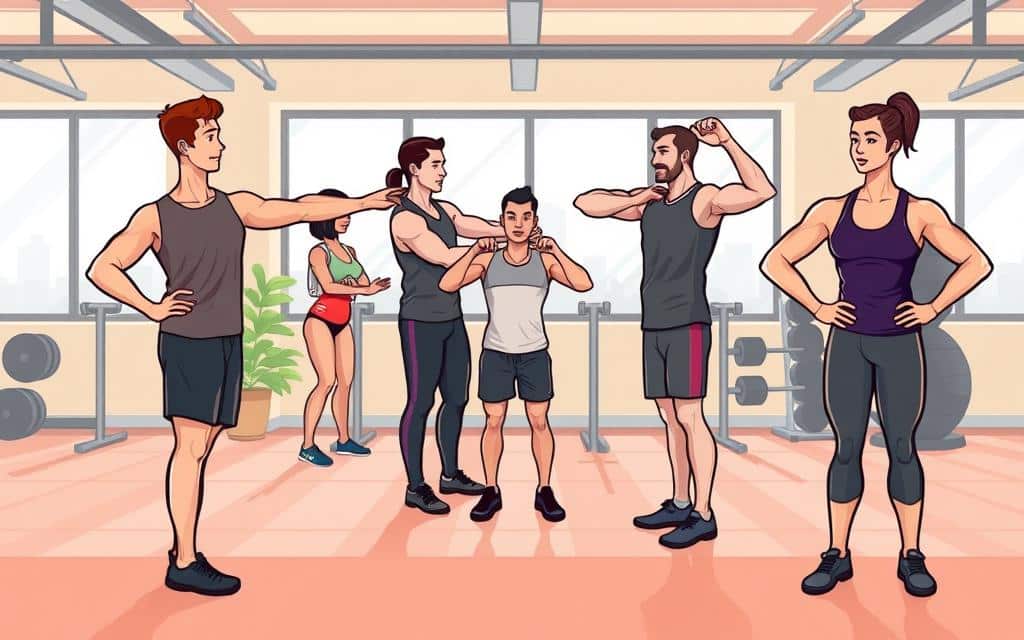
Feel that quiet buzz in your chest right before a heavy set? The best warm-up routine before lifting weights sets your body for crisp technique and sharper effort from rep one.
In just 5–10 minutes you can raise temperature, prime joints, and cue the nervous system so your first working set counts. Use focused drills that improve mobility and movement patterns, not endless jogging that steals precious time.
Think simple progressions: light tempo reps, targeted activation, and a few ramp sets that inch the bar to working weight. That approach preserves energy while delivering real benefits for strength and performance.
I’ll point you at practical cues for breathing, tempo, and load progression. When short on time, pick high-impact moves that match the session and your body. For extra recovery tips, check an effective stretching routine that pairs well with this plan.
Key Takeaways
- A targeted 5–10 minute routine can prime your body and nervous system.
- Prioritize movement-specific drills that boost mobility and coordination.
- Use ramp sets to reach working weight without wasting energy.
- Simple cues for breathing and tempo improve set one performance.
- Short or extended flows can be chosen based on available time.
- Repeatable routines build consistency and safer strength gains.
Why a Warm-Up Matters for Strength Training
A few targeted drills ready your body and mind, making that opening set feel cleaner and stronger.
Physiology: Raising core temperature and heart rate improves muscle function and circulation. That means your muscles fire better and blood reaches the right places when effort ramps up.
Joints and tissue: Heat thins synovial fluid and makes connective tissue more pliable. Your joints move deeper and hold position under load with less grinding and less chance of injury.
Mental focus: A short routine flips the switch from day-mode to training-mode. You’ll brace, cue bar path, and hit technique instead of treating the first set like a throwaway.
- Higher heart rate and temperature = smoother first heavy set.
- More blood to target muscles for better force and recovery between sets.
- Gradual load exposure builds resilience and lowers injury risk.
- Consistent primers help you chase strength goals with reliable performance.

For pairing with post-session recovery, see an effective stretching routine that supports these gains.
What the Best Warm-Up Includes
Start with a short, purpose-driven sequence that readies the exact patterns you’ll use in the session.
Light cardio: Spend 2–3 minutes on an easy pulse-raiser. A brisk bike ride or jump rope lifts heart rate without fatiguing grip or legs.
Dynamic mobility: Move through ranges that match your lifts. For squats, free your hips and ankles and add thoracic rotations for a solid torso.
Activation: Use short drills that recruit the day’s prime muscle groups. Try glute bridges before hinge work, face pulls before presses, and bodyweight squats before bar squats.
Ramp-up sets: Finish with progressive loading. Start with an empty bar or light variation, then add weight while reps drop. Keep each set crisp and intentional.
- Prioritize movements that protect joints and match the session.
- Pick exercises that fix your common tight spots.
- If time is tight, favor pattern-specific work over general fluff.
| Phase | Duration | Example |
|---|---|---|
| Cardio | 2–3 minutes | Stationary bike, light row, jump rope |
| Mobility | 2–3 minutes | Leg swings, ankle circles, T-spine rotations |
| Activation | 1–2 minutes | Glute bridges, band pull-aparts, bodyweight squats |
| Ramp-up sets | 2–4 minutes | Empty bar, 50% load, then two working progressions |
How to Warm Up Before Lift
Give yourself a quick, focused routine that turns on muscle and sharpens technique.
This simple sequence fits in 5–10 minutes and reads your movement needs. Do 3 minutes of light cyclical work like a bike or brisk walk. Keep effort low so you raise temperature without fatigue.
A simple sequence that takes 5-10 minutes
Spend 60–90 seconds on dynamic mobility that matches the day’s exercise. Use hip openers and ankle rocks for lower body or T-spine rotations and band pull-aparts for upper body.
Practical cues: tempo, breathing, and movement quality
Add 60–90 seconds of activation: bodyweight squats, glute bridges, or push-ups. Then take an empty bar for 8–10 controlled reps. Use a 2 seconds down, 1 second up tempo and crisp positions.
- Breathe low and wide. Inhale through the nose, fill the belly, brace before each rep.
- Progress load with one or two quick jumps while cutting reps. Stay far from fatigue so the last warm-up rep feels snappy.
- Keep movement quality high—no half reps and no rushing. This locks in mechanics before the weight matters.
| Phase | Duration | Action | Cue |
|---|---|---|---|
| Pulse | 3 minutes | Bike or brisk walk | Low effort, steady breathing |
| Mobility | 60–90 seconds | Leg swings, T-spine rotations | Full range, controlled tempo |
| Activation | 60–90 seconds | Glute bridges, push-ups | Connect brain to muscle |
| Ramp sets | 2–3 minutes | Empty bar then 1–2 jumps | 2s down, 1s up; brace each rep |
Build Your Ramp-Up Sets for Main Lifts
Set a clear, measurable path from the empty bar to your first heavy set. Use planned jumps and short sets so your muscles fire crisp and your energy stays fresh.
Squats: empty bar to working weight with smart jumps
Take the empty bar for 10 smooth reps. Then use 50–60% for 6–8 reps, 70–80% for 3–5 reps, and hit your first working weight feeling springy.
Tip: make bigger jumps early and smaller jumps as weights climb. That saves energy and preserves technique.
Bench press and upper body presses: shoulder-friendly progressions
Start with a shoulder primer — band pull-aparts or face pulls for 20 reps. Then do the empty bar for 10–15 crisp reps.
Follow with 60–70% for 5–8 reps, then 75–85% for 2–4 reps. Keep elbows and lats set on every rep.
Deadlifts: controlled bar speed and fewer pre-fatiguing reps
Use empty-bar hinges or RDLs for 8–10 reps. Move to 60–70% for 3–5 reps, then 75–85% for 1–3 reps.
Do not do high-rep warm sets that tire your back or grip. Focus on bar speed and setup so the first working set feels synced.
- Rest 60–90 seconds between warm-up sets — enough to reset, not cool off.
- If a warm-up rep grinds, stop that set and take a smaller jump.
- Use the same setup and cues you’ll use on heavy weight so your nervous system learns the exact pattern.
| Lift | Progression | Example jumps |
|---|---|---|
| Squats | Empty bar → 50–60% → 70–80% → working | 10 reps → 6–8 reps → 3–5 reps → work set |
| Presses | Primer → Empty bar → 60–70% → 75–85% | Band drills → 10–15 reps → 5–8 reps → 2–4 reps |
| Deadlifts | Hinge drill → 60–70% → 75–85% | 8–10 reps → 3–5 reps → 1–3 reps |
Static Stretching vs Dynamic Warm-Up
Simple movement drills prime joints and preserve the speed you need under load.
Static stretching has its place, but long holds before a session can reduce immediate strength and power.
Use quick checks—gentle holds of 5–10 seconds—to find tight areas without killing elasticity. Save the longer stretching work for after training when tissues are warm and receptive.
When static stretching helps—and why to save it for after training
Static stretching is best used post-session for flexibility and recovery. Longer holds help lengthen tissue and lock in gains without impairing performance.
An example: after leg day, do 2–3 rounds of 20–30 second quad, hamstring, and hip flexor holds to wind down and improve range safely.
Dynamic warm-up moves that protect strength and power
Before heavy sets, favor movement-based prep. Leg swings, arm circles, and thoracic rotations raise temperature and ready joints without blunting bar speed.
- Quick checks can flag tight spots—brief and targeted, not long holds.
- Dynamic mobility preserves stiffness where you need it for force production.
- Specificity: pick drills that match the lift pattern so your nervous system learns the exact movement.
| Option | When to use | Effect on strength/performance |
|---|---|---|
| Short static check (5–10s) | Pre-session for tightness screening | Minimal impact, identifies restriction |
| Dynamic mobility drills | Pre-session as primary prep | Raises temp, preserves power and speed |
| Long static holds (20–30s) | Post-session for flexibility | Improves range without hurting strength |
Warm-Up Examples by Goal and Time
Busy schedules demand quick, effective primers that match your session and goals. Pick a compact routine that gives clear rehearsal for the main pattern and saves energy for the working sets.
Five-minute “I’m short on time” routine
Quick plan: 90 seconds light cardio, 90 seconds dynamic mobility, 60 seconds activation, one short ramp set.
- Cardio: 90 seconds brisk bike or march.
- Mobility: 90 seconds pattern drills (leg swings or arm circles).
- Activation: 60 seconds of targeted drills (glute bridges or band pull-aparts).
- Ramp: 1 set of 6–8 reps with light load for movement quality.
Ten-minute strength training warm-up for peak sets
3 minutes cardio, 3 minutes dynamic work, 2 minutes activation, 2 minutes of ramp sets. Use 3 small jumps in load and keep reps low. Rest short between sets so pacing matches session demands.
Hypertrophy-focused days: higher-rep primers and movement prep
Follow the same flow but raise primer reps to 10–15. That builds pump without tiring heavy sets. For lower-body, include ankle rocks, hip openers, bodyweight squats, then 2 light barbell sets. For upper-body, add T-spine rotations, arm circles, 15–20 band pull-aparts, then empty-bar presses.
| Goal | Minutes | Key exercises |
|---|---|---|
| Quick | 5 minutes | Cardio, mobility, activation, 1 ramp set |
| Strength | 10 minutes | Cardio, targeted drills, activation, ramp sets |
| Hypertrophy | 10 minutes | Higher-rep primers, mobility, activation |
Mobility for Stubborn Joints
Mobility work should feel like a preflight check: quick, specific, and confidence-building. Pick a few targeted drills and keep each set brief so you save energy for the main lifts.
Shoulders and thoracic spine: stable pressing and pulling
Drills: 2 sets of 15–20 band pull-aparts and 30 seconds of open-book rotations.
Finish with 30 seconds of thoracic extension over a foam roller to unlock overhead range motion without stressing the low back.
Hips and ankles: deeper, safer squats and lunges
Drills: 90/90 hip flows for 30–45 seconds per side, then 5–6 controlled hip airplanes.
Do 30–45 seconds of knee-over-toe ankle rocks per leg. Add 30 seconds of deep squat shifts holding a light kettlebell to groove upright posture.
Wrists and elbows: comfort under the bar and during presses
Drills: 20–30 seconds of wrist extensions against a bench and gentle elbow flossing.
Keep every movement smooth and exploratory. You’re opening range, not forcing it. Cap mobility at a few focused exercises so your joints feel stable, not loose, when the work starts.
| Joint | Duration | Key cue |
|---|---|---|
| Shoulder/T-spine | 30–60 seconds | scapular control, tall posture |
| Hips | 30–45 seconds per side | rotate then stabilize |
| Ankles | 30–45 seconds per leg | knee over toe, heels down |
| Wrists/Elbows | 20–30 seconds | gentle mobility, pain-free range |
Common Mistakes That Raise Injury Risk
Small errors in prep raise the risk of serious setbacks. Skip the primer and your tissues and nervous system aren’t ready for heavy weights. That spike in risk injury shows up as sloppy form and early fatigue.
Don’t waste time on long, random drills that don’t match the work ahead. Static stretching right before a set can blunt force and bar speed. Save long holds for after training and use short dynamic checks first.
- Too many reps on deadlifts tires the back and grip, increasing injury risk when the weight climbs.
- Huge jumps in load can shock your system and wreck technique—use smaller interim sets.
- Rushing setup to save time often sacrifices bracing and position, which raises the risk of strain.
- Copying others ignores your body’s unique needs and creates gaps under load.
| Mistake | Consequence | Fix |
|---|---|---|
| Skip warm primer | Higher injury risk | Short, specific rehearsal for the main pattern |
| Pre-session static stretching | Reduced bar speed | Dynamic checks; save long stretching for post-session |
| Big weight jumps | Technique breakdown | Use 2–3 interim sets with controlled reps |
Conclusion
A brief, focused checklist lets you enter a working set calm, braced, and ready.
Spend 5–10 minutes on light cardio, targeted dynamic mobility, quick activation, then smart ramp sets. This routine primes muscles, raises heart rate, and increases blood flow so the first heavy set moves with intent.
Keep exercises specific to squats, deadlifts, or presses so joints and movement patterns match the work ahead. Track minutes, seconds per drill, and the number of sets and reps that leave you fresh rather than tired.
Save static stretching for post-workout to improve flexibility without undercutting strength or performance. Show up, heat, move well, and ramp smart—this simple habit protects you from injury and stacks better training days.