
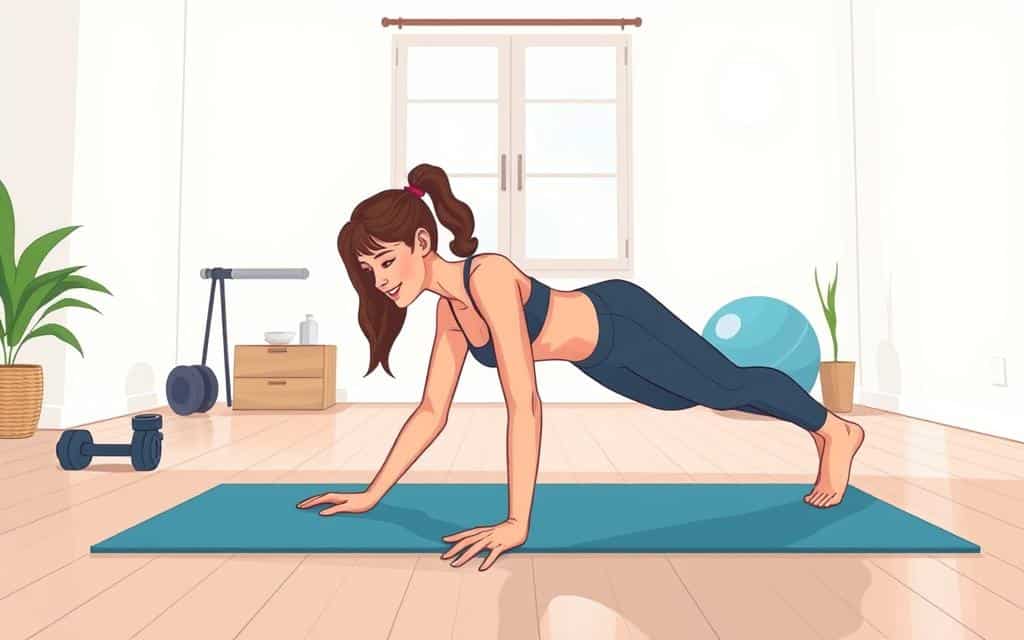
You can build a stronger midline with a simple, focused beginner abs workout at home that fits your schedule and needs no fancy gear. Feel how control and steady breathing change each rep, and notice your body wake up with better balance and posture.
The plan centers on safe, joint-friendly moves you can learn fast. I’ll show clear setup cues, form fixes, and timing so each rep targets the right muscles without straining your neck or lower back.
Expect short sessions that stack into real progress. Rest and nutrition tips are woven in so recovery helps strength gains, not just soreness.
Key Takeaways
- Simple, proven routine: builds the core without equipment.
- Joint-friendly coaching: cues to protect neck and lower back.
- Scalable circuit: timing and progress options for any pace.
- Breath and brace: learn how to fire your abs and spare other muscles.
- Recovery matters: rest and nutrition support strength gains.
Why training your core at home pays off for strength, stability, and lower back health
When your midline is reliable, lifting, twisting, and long sits stop stressing your lower back. That means fewer aches and more confidence during daily tasks.
Strength from focused core work helps your body share load across multiple muscles so one joint doesn’t take the hit.
Stability improves balance and posture. You’ll resist unwanted motion when you bend, turn, or carry grocery bags.
Short, consistent sessions save you time and remove excuses. These brief routines stack into real gains and pair well with other workouts.
- A strong core protects the lower back by bracing the spine and spreading force.
- Better control means hips and shoulders stop overcompensating, which cuts nagging pain.
- Learning proper breathing and bracing helps you protect your back during heavy or awkward lifts.
The payoff compounds: improved movement quality leads to steadier progress and fewer setbacks. Stick with short sessions, focus on control, and you’ll level up your daily strength.
Know your abs: the muscles that power movement and protect your spine
Understanding which muscles work for you makes training smarter and safer. You’ll feel effort in the right places when cues match anatomy. Below are the three main players and what they do in practical terms.
Rectus abdominis
This long sheet runs from sternum to pelvis and flexes the trunk. When you crunch, this is the prime mover. With low body fat it gives the six-pack look.
Obliques (external and internal)
These side muscles control twists and side bends. They guide rotation so the torso turns cleanly without dumping into the hips. You should feel the side of your waist engage during controlled rotations.
Transverse abdominis
This deep layer wraps like a belt around the torso. It stabilizes the spine so your leg and arm moves stay steady. When you brace correctly, expect a 360-degree tightening, not just front tension.
- Why it matters: Strong, balanced muscles coordinate movement front-to-back and side-to-side for durable function.
| Muscle | Primary action | Training cue / feel |
|---|---|---|
| Rectus abdominis | Trunk flexion; visible “six-pack” | Round the ribs to pelvis; feel the front of the midsection |
| Obliques (external & internal) | Rotation and side bending | Twist from the ribs; avoid shifting into the hips |
| Transverse abdominis | Deep stabilization of spine | Brace like a belt; feel even tension around the torso |
Set up for success: space, simple gear, and safety before you start
Before any reps, create a clear, quiet space where you can move with control. A mat-sized area on the floor is enough. Remove distractions so you can focus on breathing and position.
Quick warm-up to engage core and prep joints
Warm up 3 minutes total. Do 60 seconds of marching or hip hinges to raise blood flow.
Follow with 30 seconds of dead bug holds to wake the core and back. Move with control and stop if it hurts.
Form checks that protect your lower back on the floor
- Hands: press evenly and spread fingers; lightly screw palms into the floor to protect the shoulders.
- Shoulders & wrists: stack wrists under shoulders when on all fours to protect joints.
- Knees & hips: make sure hips sit over knees in the tabletop position for stable alignment.
- Back: keep ribs down and pelvis neutral—avoid deep arching or tucking.
- Arms: start each set by exhaling and bracing, then move an arm or leg slowly.
If your neck or back complains, regress the range or swap variations. If you manage a health condition, consult a doctor before new exercise. Controlled technique reduces injury risk.
| Setup | Key cue | Why it matters |
|---|---|---|
| Mat-sized clear area (floor) | Silence distractions | Better focus on position and breathing |
| All-fours alignment | Wrists under shoulders; hips over knees | Protects wrists, shoulders, and lower back |
| Breath & brace | Exhale then “zip up” midsection | Improves spinal stability during movement |
Foundations first: beginner-friendly core exercises with precise form cues
Focus on simple, teachable exercises that build dependable midline control. These moves teach you to engage core and protect the lower back while you learn proper timing and tension.
Dead bug
Starting position: lie on your back with knees bent and feet in tabletop. Press the lower back into the floor and brace.
Extend the right leg while reaching the left arm overhead. Pause, then switch to left leg with right arm. Move slow and keep ribs down.
Bird dog
From all fours, reach your right arm forward and left leg back. Keep a straight line from head to hips and hips level.
Hold briefly, then return. If you sway, shorten the range and focus on steady shoulders and neutral spine.
Tabletop with knee tap
Hover knees an inch off the floor and brace. Slowly lower the right knee to a light tap, then lift back to center; repeat with left knee.
If your torso shifts, keep both knees in tabletop and hold to groove tension before adding taps.
Side plank setup
Place your forearm under the shoulder. Stack or stagger legs and lift hips into a long line.
To regress, drop the bottom knee and still lift the top hip so the abs and obliques stay active.
- Keep weight centered between hands (or forearm) and toes; move with control not speed.
- Use the cue “ribs down, pelvis neutral” for every rep.
- Keep arms long and shoulders away from the ears to protect the neck.
| Exercise | Starting position | Key cue | Regression |
|---|---|---|---|
| Dead bug | Back, knees tabletop | Press lower back to floor; extend opposite arm/leg | Keep arms vertical, legs in tabletop |
| Bird dog | All fours | Head to hips straight; hips level | Shorten reach; tap toes instead of full extension |
| Tabletop knee tap | Back, knees hovered | Slowly lower one knee to light tap; keep torso steady | Hold both knees in tabletop without tapping |
| Side plank | Forearm under shoulder | Stack or stagger legs; lift hips into a line | Drop bottom knee and lift top hip |
Plank position made clear: build tension from shoulders to toes
A strong plank starts when you cue your body from shoulders down to toes. Set your hands or forearms under the shoulders and step the feet back until you form one straight line from head to heels.
High plank: press through your palms, squeeze glutes and quads, and lock the midsection. Keep eyes slightly ahead, not tucked under your chin.
Forearm plank: drop to your forearms to ease wrist stress while keeping the same tight line through the core. Think “pull the floor apart” with your back arms and toes to stabilize.
Lower‑ab options and safe mods
Toe touches and seated straight‑leg lift target the lower abs without yanking the lower back. Lift with control; avoid swinging the arms or dropping the ribs.
- If your lower back sags, cut the hold to quality seconds or drop to knees.
- Use a 90° angle at hips or knees when straight legs flare pain; range beats reach every time.
- Cap each hold before form slips—short, crisp reps win over long, sloppy ones.
| Variation | Key cue | When to use |
|---|---|---|
| High plank | Wrists under shoulders; long line head→heels | Builds full-body tension |
| Forearm plank | Elbows under shoulders; neutral spine | Reduces wrist load, same core demand |
| Seated straight‑leg lift | Sit tall; brace and lift one leg a few inches | Targets lower abs with less back stress |
Want more core variety? Try a guided pilates sequence for core strength for targeted progress and safer lower‑back work: pilates for core strength.
Beginner abs workout at home: a step-by-step circuit you can trust
Follow this guided sequence for a compact circuit that favors control over ego. Set a timer and move with intent. The plan is simple to follow and easy to repeat.
Round structure: work, rest, and how many circuits to complete
Do 30–40 seconds work, 20 seconds rest per move. Complete 2–3 rounds depending on time and energy. Rest 40 seconds between rounds to reset.
Exercise flow
- Dead bug
- Plank with knee taps (plank knee)
- Toe touch
- Side plank — right side, then left side
- Bird dog
Coaching cues
- Dead bug: press the lower back to the floor, extend left leg with right arm, then switch to right leg with left arm.
- Plank with knee taps: hold a solid plank position (high plank or forearm), lightly tap right knee then left knee—avoid rocking the body.
- Toe touch: legs up, reach, pause, and slowly lower back to the starting position to hit the lower abs.
- Side plank: hold 20–30 seconds per side; make sure the elbow sits under the shoulder and hips stay lifted.
- Bird dog: reach opposite hand and leg long, pause with neutral head, then reset.
Keep steady breaths: exhale to brace, then move. If form slips, shorten the work time rather than chase more reps. Quality always wins over quantity.
| Move | Work / Rest | Key cue |
|---|---|---|
| Dead bug | 30–40s / 20s | Press low back to floor; controlled limbs |
| Plank with knee taps | 30–40s / 20s | Stable plank position; light taps with right knee & left knee |
| Side plank | 20–30s per side | Elbow under shoulder; hips lifted; toes stacked or staggered |
Timing, reps, and progress: how to scale week by week
Treat each session like a checkpoint: measure control first, then add seconds or sets. Start modest and build a reliable base of core strength before chasing longer holds or harder moves.
Beginner intervals
Use this simple interval template to structure your days without overdoing it.
- Week 1–2: 20–30 seconds per move, 20 seconds rest, 2 rounds. Focus on smooth reps and steady breathing to build core control.
- Week 3–4: 30–40 seconds per move, 20 seconds rest, 2–3 rounds. Add a short pause at the toughest point on lower abs moves.
Progress options:
- Keep a 90-degree angle at hips or knees early, then lengthen lever arms as control improves.
- Slow the eccentric — count to three as you lower a leg in dead bugs or during toe reaches.
- Alternate starting side each set; begin with the right leg one set, the left leg the next for balanced coordination.
- When positions are steady, swap in rocking planks or longer side holds to challenge stability.
| Marker | What to change | Why it works |
|---|---|---|
| Hold own position | Add +5–10 seconds | Builds time under tension without sacrificing form |
| Controlled reps | Slow eccentrics to 3s | Increases muscle recruitment in abs and core |
| Form breakdown | Cut work time by 5 seconds | Protects joints and teaches consistency |
Make it easier or harder without losing good form
Dialing load up or down shouldn’t cost your form — here’s how to scale smartly.
Start with gentle regressions if your core or hips feel weak. Hold tabletop braces, use knees-down planks, and shorten leg lowers so the floor contact and brace stay solid.
When you’re steady, pick one variable to increase: time, range, or tempo. Add longer holds, extend one leg at a time (left leg then right leg), or try controlled rocking planks for added challenge.
Clear entry points
- Regressions: tabletop holds, knees-down plank, smaller leg lowers for the lower abs and stability.
- Progressions: rocking plank, plank knee-to-elbow, and side plank holds while keeping hips level and ribs tucked.
- In high plank: spread fingers, press the floor, and squeeze legs from toes to head for full-body tension.
Exact cues to self-adjust
Keep hips square during unilateral moves. If they twist, reduce range or slow the tempo until control returns.
| Goal | Action | Key cue |
|---|---|---|
| Build stability | Knees-down plank | Rib and pelvis locked; light toe squeeze |
| Challenge balance | Plank knee-to-elbow | Move slow; keep hips level; right knee taps only if brace holds |
| Lower‑abs load | Single leg extension | Extend one leg, keep floor contact and brace before both |
Progress one variable at a time. Think “lock the ribs and pelvis” so the abs and surrounding muscles do the work, not your spine. Alternate right knee and left leg leads to balance coordination and steady gains.
Technique pitfalls that sabotage your core gains
Small technical errors quietly eat away at progress and invite aches. Spotting these flaws mid‑set helps you fix them fast and keep the focus on the right muscles.
Keep a neutral spine and avoid momentum. If your lower back hollows during planks or leg lowers, exhale, tuck the ribs toward the pelvis, and brace before you move.
In plank holds, make sure your body forms a straight line from head to heels. Keep elbows or hands under the shoulders so the load sits on the core, not the joints.
- If hips sag: squeeze glutes and quads and recheck alignment—this restores the straight line.
- Rushing reps: pause at the hardest point, then slowly lower to own the motion and protect the back.
- Side plank leaks: press the forearm into the floor, lift through the underside waist, and keep the shoulder centered—not shrugged.
- Any nagging knee or back pain: shorten range or reduce load until your core can stabilize the position.
| Mistake | Sign on the set | Immediate fix |
|---|---|---|
| Arched lower back | Visible hollowing; discomfort in back | Exhale, tuck ribs to pelvis; brace before moving |
| Sagging hips | Broken straight line; hips drop toward floor | Squeeze glutes/quads; lift hips to restore line |
| Shoulder hike or collapse | Shoulder rounds toward ear; wrist or forearm strain | Stack shoulder over wrist/forearm; pull shoulder blades down |
| Fast, uncontrolled reps | Momentum; reduced muscle tension | Pause at peak, then slowly lower with control |
Treat every setup as a rep: breathe, brace, check position, then move. Film a short set if you can—small angle tweaks on the floor fix big leaks in tension and help your core level up safely.
Recovery, rest days, and simple nutrition for visible results
Rest days are not downtime — they’re the repair shop where strength gets built. Letting tissue and central nervous systems reset makes your next session better. Think of recovery as part of the plan, not an optional extra.
Why rest days build strength and reduce injury risk
Plan clear rest days between core sessions so your muscles repair microtears. That repair is how strength appears, not just from the reps.
Giving yourself time lowers the chance of nagging pain in your back and keeps form crisp on planks and other moves.
Follow the CDC guidance for a baseline: aim for roughly 150 minutes of moderate activity each week plus two resistance sessions to cover strength and cardio needs.
Nutrition pointers: protein, fiber, and consistency for body composition
Keep protein at every meal to support repair. Add fiber from whole grains, beans, fruit, and vegetables to help appetite and composition.
- Plan rest days between core-focused sessions so you come back stronger, not sore.
- Stay consistent: about 150 minutes weekly plus two strength sessions is a solid baseline over time.
- Protein + fiber: lean protein with whole foods helps muscles and body composition.
- Hydrate & sleep: aim for 7–9 hours—both change how you perform and how you eat.
- Post-session cool-down: walk, nasal-breathe, and gently stretch hips and thoracic spine after tough sets.
| Focus | Why it matters | When to use | Quick tip |
|---|---|---|---|
| Planned rest day | Allows microtears to repair and reduces injury risk | After 1–2 intense core sessions or when soreness lingers | Schedule non‑training active recovery like walking |
| Hydration & sleep | Improves recovery, appetite control, and performance | Daily priority, especially the night after a hard session | Drink water steadily; aim for 7–9 hours sleep |
| Protein each meal | Supports muscle repair and helps maintain lean mass | Include 20–30g per main meal or proportional to body size | Choose lean sources: fish, poultry, eggs, dairy, or legumes |
| Cool-down & mobility | Reduces stiffness and restores movement quality | After planks, lower‑ab sets, or any intense session | 5–10 minutes of walking plus hip and thoracic stretches |
Progress comes from repeatable effort. Keep a sustainable rhythm, track how your back and midsection feel, and adjust volume so you’re challenged but not wrecked. Small, steady steps beat sporadic all‑out days for long‑term change.
Conclusion
Finish strong: consistent, clean practice is the engine behind real change. Master these exercises, own your positions, and let your core guide each move.
Keep sessions short and focused so your back feels better week by week. Choose control over speed—clean reps build stronger abs and transfer to everything you do.
Progress one variable at a time and listen to leg and hip control to decide when to level up. Anchor this plan into your week, recover well, and eat simply—consistency creates results.
Start today with one round; if it feels good, add a round tomorrow and build from there. Your body is ready—take the next step with this simple, repeatable workout.