
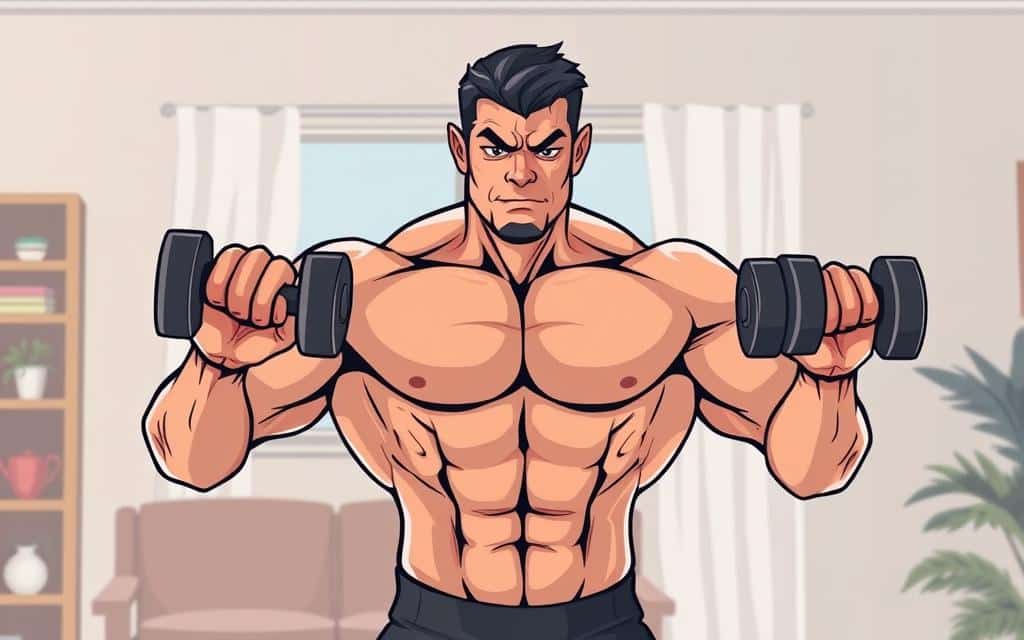
dumbbell chest workout at home can feel like a puzzle when you only have a pair of weights and the floor, but it’s a surprisingly complete way to build pressing power and shape. Picture crisp, controlled presses and squeeze flyes that make your muscles hum without a bulky bench in the corner.
Set a small space, warm your shoulders, and pick loads that leave 1–3 reps in reserve. Start with floor presses and flyes for safe depth, add push-up deficits for range, and use pullovers for a long-lever stretch.
Expect a simple template with beginner, strength, and hypertrophy tracks, tempo and rest rules, plus standing variations to bias the upper portion if you lack an incline. Follow form checks and progression over 6–10 weeks and you’ll get real strength and visible definition.
Key Takeaways
- Floor-based pressing and fly patterns let you train safely without a bench.
- Use RPE, multiple rep ranges, and a 6–10 week plan to progress strength and size.
- Warm shoulders, pick challenging loads, and keep 1–3 reps in reserve on sets.
- Standing moves and angle tweaks can emphasize upper fibers when needed.
- Tempo, rest, and simple form checkpoints make every session count.
What you need to start strong at home
Clear a 6–8 foot area and place your gear within arm’s reach so you can press, fly, and move without interruptions.
Space, equipment, and smart setup
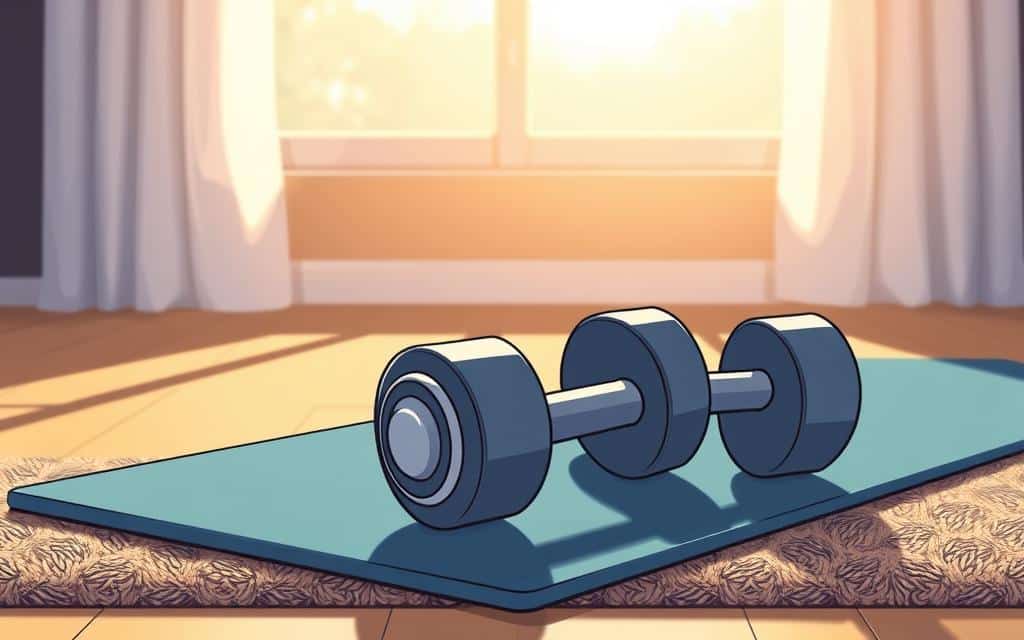
Keep the area uncluttered. A pair of hex dumbbells sits flat for push-up deficits and renegade moves. Adjustable dumbbells save space and cover multiple loads.
Optional items: a yoga mat for traction and a folded towel under the wrist if you lack hex heads. Place weights on the side you’ll reach to start, and set a timer to track rest.
Warm-up that protects shoulders and boosts range of motion
Warm in 5–7 minutes: 30–60 seconds of arm circles and band pull-aparts. Follow with scapular push-ups and light dead hangs if available.
Add controlled articular rotations to explore range motion safely. Prime pressing with 1–2 light floor presses or knee push-ups, focusing on scapular retraction and depression.
- Cue checklist: feet planted, ribs down, shoulders set back and down before the first rep.
- Choose weights that let you move smoothly with 1–3 reps in reserve; treat week one as form-first.
- Note: 15–30° incline angles on a bench bias the upper portion when you have one.
How to press safely: shoulder-friendly mechanics that matter
Good pressing starts with a stacked setup — tight back, packed shoulders, and a grip that feels natural. Set this before the first rep and keep it. Safe mechanics protect joints and let you build force without pain.
Grip, elbow path, and scapular position for a solid press
Set your scapulae by pulling your shoulder blades down and back into the bench or floor. Keep them held rather than letting them wander as reps pile up.
- Grip: neutral to slightly turned in feels kinder on the shoulder and elbow.
- Elbow path: aim for about a 30–45° angle from your torso to spare the shoulder.
- Starting position: wrists stacked over elbows, forearms vertical, ribs down, light glute tension for stability.
- Cue: “bend the weight” to keep tension through the chest and shoulders packed.
Finding the right range of motion on the floor vs. bench
On the floor the ground limits depth — let your elbows kiss the floor, then drive up. That stop is a safe, repeatable range motion for pressing strength.
On the bench you can lower further until you feel a full but comfortable stretch in the chest. Don’t chase depth if your shoulder position breaks — reduce range and tighten your back instead.
Control the negative for 2–3 seconds, pause lightly near the bottom, and press smoothly. If the shoulder cramps, shorten the motion, check elbow tracking, and stay tight.
Dumbbell chest workout at home: a simple template that works
Build a clear plan with three tracks—beginner, strength, and hypertrophy—and follow it for 6–10 weeks.
Quick primer: train the pressing pattern twice weekly, log each set, and use a double-progression model: add reps first, then add small weight jumps.
Tracks, sets, reps, and practical rules
- Beginner (2x/week): Floor press 3×8–10 @ RPE 7–8; Floor flyes 2×10–12 @ RPE 8; Push-ups 2xAMRAP leaving 1–2 reps; Pullovers 2×10–15 @ RPE 8.
- Strength (2x/week): Flat bench press 4×5–8 @ RPE 7–8; Incline press or feet-elevated push-ups 4×5–8; Flyes 3×10–12 @ RPE 8–9.
- Hypertrophy (2–3x/week): Incline press 4×6–10 @ RPE 7–8; Slight decline/hammer press 4×8–12; Flyes 4×10–15; Pullovers 3×12–15.
Weekly schedule and progression
Rotate sessions Mon/Thu or Tue/Fri to allow recovery. Cap each session at 45–60 minutes to stay consistent and fresh.
| Focus | Sessions/week | Key lifts | Progression rule |
|---|---|---|---|
| Beginner | 2 | Floor press, flyes, push-ups, pullovers | Add 1 rep if top reps not met; add 2.5–5 lb when ranges filled |
| Strength | 2 | Flat bench, incline/deficit press, flyes | Prioritize top-end reps, then add small weight jumps |
| Hypertrophy | 2–3 | Incline press, hammer press, high-rep flyes | Increase reps within range, then raise weight; rotate lifts every 6–10 weeks |
Logging tip: track sets, reps, RPE, and weight. If you hit top reps across all sets, add 2.5–5 lb next cycle. If not, add one rep the next session.
Floor press: your no-bench foundation for chest strength
Think of the floor press as your baseline press — stable, simple, and kind to the shoulders while still loading the pecs and triceps. This movement teaches a safe range of motion by using the floor as a hard stop and gives you a repeatable position for steady progress.
Setup, starting position, and smooth pressing motion
Setup: sit behind the weights, roll back with control, and lock your starting position with shoulder blades set and ribs down. Plant your feet lightly for a stable base.
Keep forearms vertical. Lower until your elbows touch the floor — that contact is your safe depth cue. Use a 2–3 second descent, pause briefly at the bottom, then press smoothly to full extension without slamming.
Alternating and hammer-grip variations for triceps and stability
The hammer-grip version uses a neutral hand position to reduce shoulder stress and push more load into the triceps at lockout.
The alternating press asks one side to hold while the other lowers. It boosts anti-rotation control, fixes unilateral imbalances, and forces core engagement.
- Keep elbows at about 30–45° from your torso to protect the shoulder and target the pecs effectively.
- If you struggle to get into position, prop the weights on your thighs, then rock back to the floor for a safer setup.
- Progress by adding small weight jumps, extra reps in the target range, or short holds at the bottom to build control.
Floor flyes: safer stretch and strong adduction without a bench
Floor flyes let you get a wide, controllable stretch while the ground limits depth. Use a steady arc from the shoulder and a slight elbow bend to keep the work in the chest and away from the joint.
Start light. Groove the arc first before chasing big range motion. Keep the elbow angle constant and move from the shoulder joint, not the arms.
Elbow bend, shoulder pivot, and controlled arc
Lower in a wide, slow arc until your elbows gently touch the floor — that contact is your built-in depth limiter. Pause briefly, then “hug” the weight back up with a chest squeeze. Avoid clanking the dumbbells together at the top.
- Begin with a light dumbbell to learn the path.
- Fix the slight elbow bend; all motion comes from the shoulder to bias adduction.
- Keep shoulders set and ribs down so the chest does the work, not the neck or low back.
- Progress by slowing tempo (3–4s down), small weight bumps, or 10–15 rep sets.
| Cue | Common mistake | Progression |
|---|---|---|
| Fixed elbow angle; shoulder pivot | Flared elbows or pulling with the arms | Slow tempo, add reps, then small weight increases |
| Use the floor as stop for safe range motion | Lowering past comfortable stretch or shrugging shoulders | Reduce range, adjust elbow bend, rebuild control |
| Pause and squeeze at top; controlled arc | Clanking weights or using momentum | Light sets to groove form, then ramp load |
Dumbbell push-up variations for depth and wrist comfort
A simple handle setup gives you extra range while keeping your wrists happy during presses. Use hex handles to raise your hands slightly and reduce painful wrist extension. This small change creates a safe deficit so you can lower with more pec stretch.
Standard deficit push-up setup and cues
Setup: place hex handles shoulder-width or a touch wider. Brace your body in a straight line from head to heels. Squeeze your glutes so hips don’t sag.
Lower until your chest dips below the handle height, then press back without flaring elbows. Move slowly on the way down and pause just off the floor to remove bounce and build strength.
Renegade push-up for core control and upper-body balance
The renegade mixes row and press for a full-body challenge. Sequence: row left, push-up, row right, repeat. Keep hips square to resist rotation and keep the spine neutral.
- Widen your feet for a more stable base during rows.
- Keep a 45° elbow path if shoulders feel cranky.
- Focus on controlled reps to boost core anti-rotation and upper-body strength.
Squeeze and crush-grip presses for inner chest tension
Combine pressing and a constant inward squeeze to keep tension on the inner fibers for every rep. This method blends isometric adduction with a straight press so the sternum stays loaded through the full motion.
How to maintain constant pec tension through the press
Setup: hold the weights together and actively squeeze like you want to crush them. That sustained squeeze keeps the inner chest and triceps engaged.
Alignment cues: keep wrists straight and forearms vertical. Lower under control without letting the load drift down the torso. Keep the handles centered over the sternum.
- Hold the weights together and squeeze to light up the inner chest.
- Keep wrists straight; forearms vertical for efficient load sharing with triceps.
- Maintain squeeze from bottom to top — no relaxed middle range.
- Use moderate reps (10–15) to feel tension without losing position.
- Reduce load if wrists strain; focus on cleaner motion.
| Focus | Grip cue | Reps | Main benefit |
|---|---|---|---|
| Squeeze press | Hands pressed together, active adduction | 10–15 | Constant inner pec tension, stronger lockout |
| Crush-grip press | Firm crush throughout motion | 10–15 | Inner chest emphasis, added triceps work |
| Wrist-sparing option | Lighten load, focus on vertical forearms | 8–12 | Protects wrists while preserving tension |
Pullovers on the floor: stretch the chest while keeping shoulders happy
Lie flat with knees bent and learn to control a long lever as you move the weight behind your head. This simple floor pullover teaches safe range, breath timing, and tension control without overstressing the shoulders.
How to set up: hold one dumbbell with both hands, keep a slight elbow bend, and place the weight over your sternum to start. Use a steady arc and stop where your shoulders feel stable.
Key mechanics: lower the weight in a smooth motion behind the head until it gently touches the floor or your safe end range. Inhale on the descent for stability; exhale as you pull the weight back using chest and lats.
- Keep ribs down and lower back neutral so the stretch targets chest and lats, not your spine.
- Use higher reps (10–20) and slow lowers to build control with lighter loads.
- If your shoulders protest, shorten the range and tighten the grip to stabilize the path.
Target the upper chest at home: incline options without a bench
If you lack an incline bench, simple standing moves can still bias the upper fibers with minimal gear. These variations use a low-to-high path and steady adduction to shift load up the collarbone area while keeping the shoulders safe.
Standing upward fly mechanics
Start with weights at your thighs. Keep a slight elbow bend and sweep the arms up and in toward the upper chest. Think “low to high” on each rep.
- Set the shoulder blades down and back before you move.
- Stop just short of shoulder height to protect the joint.
- Use smooth arcs and controlled motion for 10–15 reps.
Svend-style press cues
Hold one weight pressed between your palms at the sternum. Squeeze hard and press it forward while keeping the hands close together.
- Maintain max adduction—don’t let the weight drift or the elbows flare.
- Keep tension from start to finish and drive the press slightly upward.
- Use controlled reps in the 10–15 range and focus on the peak squeeze.
Tip: combine both moves in a circuit to bias the upper chest and reinforce safe pressing position without an incline.
If you have a bench: flat, incline, and slight decline options
If you’ve got a bench, you open up cleaner pressing angles and more controlled ranges than floor work alone. That extra range lets you target different parts of the chest with small angle and tempo changes.
Dumbbell bench press cues that spare your shoulders
Setup: glutes tight, feet planted, and shoulder blades pulled back and down for a locked position. Keep wrists stacked over elbows and maintain a short, stable spine.
Path: lower to a strong but comfortable stretch. You don’t need to tap the weights to the sternum every rep.
Incline angles and tempo tweaks for the upper chest
- Flat: feet planted, glutes on the bench, shoulder blades locked, wrists stacked over elbows.
- Elbows: keep them about 30–45° from your torso to protect the shoulder and improve loading.
- Incline: set 15–30°; turn the weights in slightly and press on a smooth arc to bias upper fibers.
- Decline: slight negative angle to emphasize lower fibers without straining the shoulder.
- Tempo tweak: 3s down, 1s pause, controlled press — builds size while reducing the need for heavier loads and limits excessive range motion.
| Variation | Key cue | Main benefit |
|---|---|---|
| Flat bench press | Stable base, locked blades | Max mid-chest loading |
| Incline dumbbell bench | 15–30° angle, inward turn | Upper chest emphasis |
| Slight decline | Modest negative angle | Lower pec focus |
If your shoulders protest, shorten the range and check elbow tracking. Small changes in position solve most pain and keep progress steady.
Technique checkpoints: common mistakes that stall progress
Before you add weight, lock the starting position. Set your scapula, stack wrists over elbows, and breathe into a braced core. That repeatable start saves reps and prevents sloppy form.
- Problem: Elbows flared wide. Fix: Track the elbows under the load at about a 45° angle to protect the shoulders and direct force into the chest.
- Problem: No scapular set. Fix: Pin the blades down and back before every rep for a reliable pressing base and safer bench depth.
- Problem: Bouncing off the floor or sternum. Fix: Control the eccentric for 2–3 seconds and treat the floor as a pause, not a spring.
- Problem: Inconsistent range. Fix: Pick a depth marker and hit it each set so your movement becomes measurable and progressive.
- Problem: Sagging lower back. Fix: Brace the core, plant feet, and keep ribs down to protect the spine and keep power moving through the chest.
| Fault | Quick cue | Why it matters |
|---|---|---|
| Elbows flared | 45° elbow path | Spare shoulders, focus pecs |
| No scapular set | Pin blades down/back | Stable pressing base |
| Bouncing | Slow eccentrics | True muscle work, less joint stress |
Programming details: load, tempo, and rest times that build muscle
Programming trims guesswork. Match load, tempo, and rest so each set moves you forward. Use simple rules and you’ll recover faster and lift smarter.
Choosing weights and when to add load
Pick a weight that leaves 1–3 reps in reserve on your last set. For main presses use RPE 7–8 (2–3 RIR). For isolation work aim RPE 8–9.
- Rest: 90–150 seconds on compounds, 60–90 seconds on flyes and squeeze work.
- Progression: add weight when you hit the top of the rep range across sets with solid form.
- Keep advanced work minimal: use clusters or drop sets on 1–2 lifts per session so recovery stays on track.
Tempo, clusters, and drop sets to boost time under tension
Use tempos like 3-0-1-0 on presses to increase tension without always chasing bigger weight. Try cluster sets (e.g., 2 reps, brief pause, 2 reps) to keep force fresh inside a set.
| Method | When | Benefit |
|---|---|---|
| Slow eccentric (3s) | Main press | More muscle time under tension |
| Cluster | Strength phases | Higher quality reps |
| Drop set | Finishers | Extra fatigue for size |
What muscles you’ll feel and why this workout pays off
You’ll feel the pectoralis major doing most of the work. It drives adduction and pressing across angles. The pectoralis minor helps position the ribcage and shoulder blade for a cleaner press.
Secondary movers include the triceps for every lockout and the anterior deltoids for the initial push. The serratus anterior and subclavius steady the clavicle and scapula so your shoulder stays healthy.
Smaller stabilizers in your rotator cuff and core fire to keep the arm path steady. Standing and floor variations force those stabilizers to work harder. That builds real-world pressing strength that transfers to daily tasks.
- You’ll mainly feel the pectoralis major driving pressing strength across angles.
- Triceps assist lockouts, while delts and serratus guide shoulder motion.
- Stabilizers improve push-up carryover and practical pushing tasks.
- Benefits: stronger presses, better shoulder control, and a fuller upper torso that makes daily moves easier.
| Role | Primary muscles | Functional benefit |
|---|---|---|
| Prime mover | Pectoralis major / minor | Power for pushing and adduction |
| Assist | Triceps, anterior deltoid | Lockout strength and initial drive |
| Stabilize | Serratus anterior, rotator cuff | Shoulder control and safer range of motion |
Conclusion
Finish with a clear plan: two weekly sessions and about 12–14 total sets is a simple, effective target. Keep sessions focused and short so you stay consistent.
Track each set, note RPE, and add a rep or a small load when you earn it. Use presses, fly variations, push patterns, and pullovers as your core exercises to cover strength and size without a bench.
Rotate movements or tempos every 6–10 weeks. Lock the basics: scapular set, 30–45° elbow path, and slow, controlled lowers. Do that and your results stack up fast.
Start your next session with the template that matches your goal and build from there. Stay consistent, keep the form tight, and level up with smart progress.