
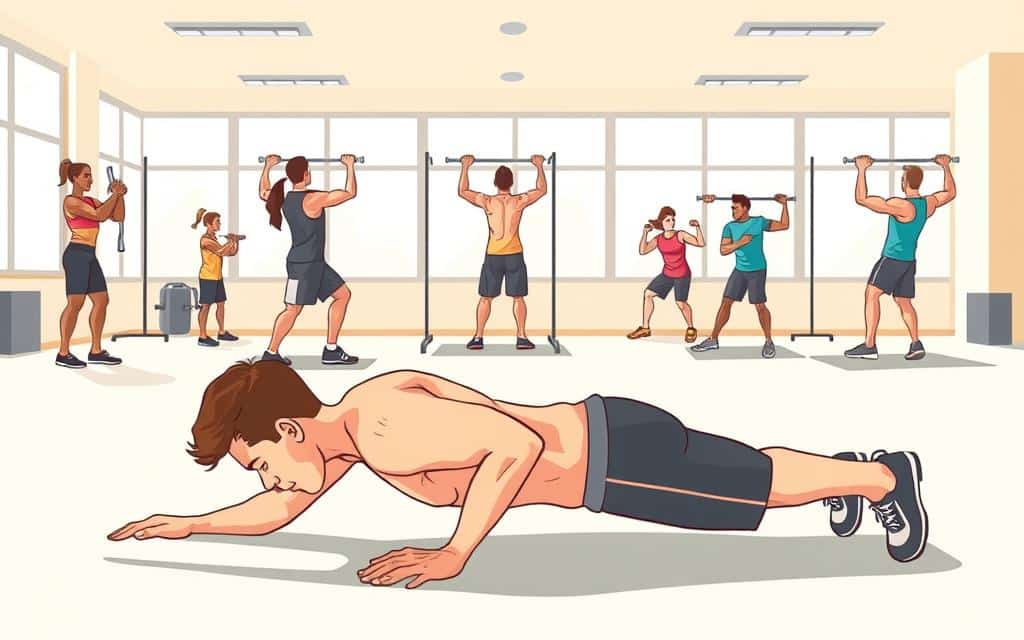
Calisthenics wakes up the body in ways a crowded gym rarely does — you feel the pull of gravity, the certainty of progress, and the sting of honest effort in your hands and shoulders.
Start with a handful of moves and a small plan. This guide shows you how to use your own weight to build real strength, control, and confidence.
You’ll learn practical training cues, easy-to-scale variations like inclines and bands, and safety rules that protect wrists, shoulders, and back. Minimal gear — a bar, a wall, and one resistance band — is all you need to train at home, in a park, or at a gym.
Follow strict, controlled reps and train 2–4 days a week. With clear progressions and simple weekly routines, you’ll stack wins fast and move toward skills like handstands and pull-ups without guessing or hitting plateaus.
Key Takeaways
- Use your own weight to build strength and control with minimal gear.
- Focus on strict reps and smart progressions over momentum.
- Train 2–4 days weekly and prioritize recovery for fast gains.
- Start with push, pull, core, and lower-body basics then layer skills.
- Warm-ups and pain rules keep your wrists, shoulders, and back safe.
What calisthenics is and why it works for true beginners
Bodyweight training uses simple movement to build real strength and better control of your motion. In plain terms, it’s a system of exercises that rely on your own weight and gravity as the load.
Why it helps you: the low barrier to entry means you can start today. Progressions scale cleanly — change leverage, angle, or assistance and the same move becomes harder or easier.
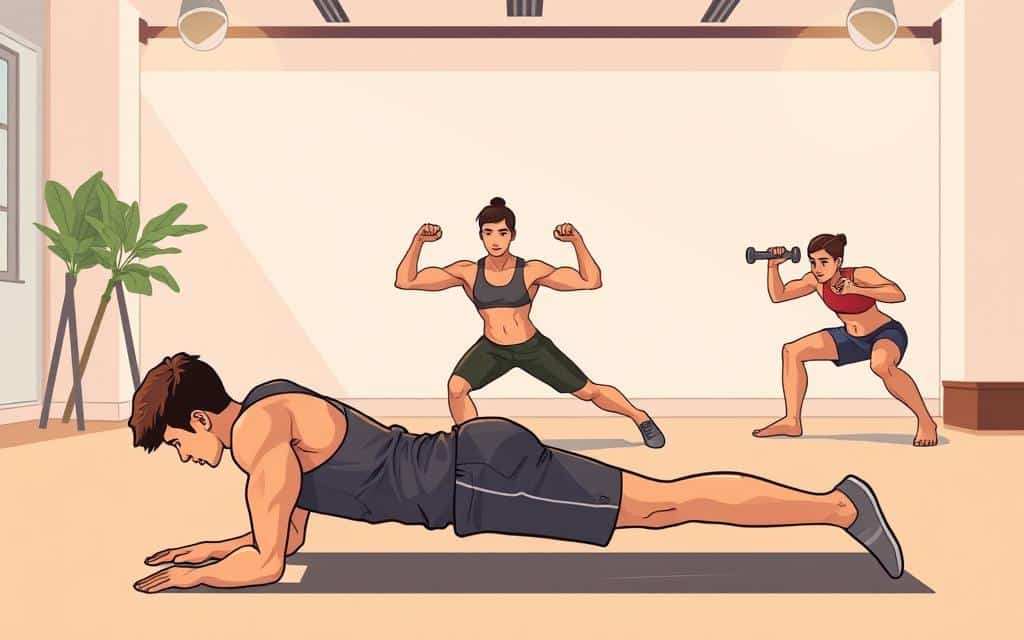
Expect full-body payoffs: arms, triceps, chest, back, core, and legs all work in natural patterns that improve balance and coordination. That mix builds practical strength and flexibility that transfers to daily life and sport.
- Minimal gear: a bar and a resistance band unlock rows, dips, and assisted pull-ups.
- Safe by design: strict technique and full range reduce joint stress and protect the back and shoulders.
- Real muscle gains: consistent sets, progressive reps, and steady training stimulate growth similar to external weight programs.
In short, this guide gives you a program that teaches skill and fitness together. Short sessions fit busy schedules, and progress is easy to track: when reps feel smooth, you tweak leverage, tempo, or assistance and level up.
Warm up the right way before a calisthenics workout
A brief, targeted warm-up prepares your heart, joints, and nervous system to handle skill work safely.
Raise your heart rate: invisible jump rope or jumping jacks
Do 2–3 minutes of invisible jump rope or 50 jumping jacks to raise your heart rate quickly. These low-equipment moves warm calves, legs, shoulders, and arms.
Mobility and dynamic stretching for shoulders, wrists, hips, and spine
Use dynamic moves — not long holds — to improve range motion and flexibility while keeping power. Add hip openers and thoracic rotations to free the spine so the shoulder can stack properly in pushing work.
Activation and skill-specific prep: bands, hollow body, and alignment drills
- Shoulder primer: 2–3 sets of 15 band pull-aparts, face pulls, and external rotations to warm the shoulder joint.
- Core & posture: 20–30s hollow body hold (press low back to the floor) then 20–30s superman hold to engage posterior muscles.
- Skill drills: 1–2 light sets of your first exercise (e.g., incline push-ups) with slow, controlled reps. If you work handstands or pull-ups, add scapular pulls or wall line drills for balance and alignment.
Keep total warm-up time about 8–10 minutes so you’re ready but not tired. Repeat these primers two to three times a week to build a reliable routine and level up your body control in every calisthenics session.
Upper-body basics: pushing strength you can build at home
Pushing strength starts with control — not heavy weight — and you can train it anywhere. Learn a clean position, steady tempo, and tight tension to build chest, shoulders, triceps, and core.
Incline push-ups to floor push-ups: chest, shoulders, triceps, and core
Start on an incline (bench or table) so your body is straight from head to heels. Lead with your chest, not your face. Keep elbows at about 45° from the torso.
Use a 2–3 second negative on floor push-ups as you lower the hands toward the floor. Squeeze glutes, drive toes into the floor, and stop 1–2 reps before form breaks.
Dips on bars or a bench: strict form for safer progress
On parallel bars or a bench, keep a tall chest and packed shoulders. Let elbows track back and pause near 90° before pressing to lockout.
- Regressions: incline push-ups, bench dips, or band-assisted dips.
- Progressions: lower the incline, add tempo, or reduce band assistance to increase strength.
- Sets & reps: 2–3 sets of 6–12 reps, rest 60–90 seconds; stop short of failure.
| Exercise | Key Cue | Tempo | Scale |
|---|---|---|---|
| Incline Push-up | Straight line, chest lead | 2s down / 1s up | Lower incline → floor |
| Floor Push-up | Elbows ~45°, glutes tight | 2–3s negative | Add reps or slow tempo |
| Bench / Bar Dips | Tall chest, 90° pause | Controlled descent | Band assist → unassisted |
Pulling strength for beginners: rows and pull-ups without momentum
Building a solid pull begins with tension, control, and a plan that removes momentum. Slow, strict reps teach your body to link shoulders, back, and hips into one efficient unit.
Inverted rows to develop horizontal pulling
Set a bar at waist height and walk your feet forward until your body is a straight line. Keep glutes and abs tight.
Pull your chest to the bar, not your chin. Squeeze the shoulder blades first, then drive elbows back and down.
Assisted pull-ups with strict control
Use a looped band or machine to reduce weight while keeping a neutral grip. Start each rep with a scapular set — depress and retract — then pull until your chest rises.
Control the descent for 2–3 seconds. Avoid kipping or swinging; momentum steals strength and stresses the shoulders.
Grip and shoulder positioning
- Thumb around the bar, wrists neutral.
- Forearms vertical at the top to protect elbows and shoulders.
- Scale rows by bending knees for easier reps or straightening legs and lowering the bar to make them harder.
| Exercise | Key Cue | Tempo | Scale |
|---|---|---|---|
| Inverted Row | Chest to bar, tight core | 2s up / 2s down | Higher bar → easier; lower bar → harder |
| Assisted Pull-up | Scapular set, neutral grip | Slow negative 2–3s | Band assist or machine → unassisted |
| Grip Focus | Thumb wrap, wrists neutral | Maintain position each rep | Use thinner bar or towel grips to progress |
Core and lower-body fundamentals that support every calisthenics exercise
A solid midline and strong legs make every movement safer and more powerful. This section gives crisp setup cues and simple regressions so you can train alignment and control every session.
Hollow body hold and plank: teach bracing and body control
Hollow body: lie on the floor, press your low back down, lift arms and legs slightly. Breathe steady and hold 20–40 seconds. If that’s too hard, bend the knees or lift just the arms.
Plank: elbows under shoulders, ribs down, glutes tight. Keep one long position from head to heels. Start with 20–40 seconds and cue the core on every breath.
Squats and sumo squats: depth, balance, and knee tracking
Bodyweight squat: feet shoulder-width, push knees out, sit hips back, keep heels down. Find a depth you control and pause for one second at the bottom to reinforce position.
Sumo squat: wider stance, toes slightly out to target inner thigh strength and balance. Use a shallow box or chair to regress depth while keeping the same knee tracking cues.
Lateral lunges and superman: stability and posterior chain strength
Lateral lunge: step wide, sit into the working hip, keep the other leg long, drive back through the heel. Aim for 8–12 reps per side.
Superman: lie prone, squeeze glutes, lift arms and legs a few inches, hold 3–5 seconds, lower with control. This balances ab-focused work and builds posterior chain strength.
- Cue the core on every rep so squats and lunges stay stable and your spine stays happy.
- Start with 2–3 sets of 8–12 reps for squats and lunges; holds 20–40 seconds, rest 45–75 seconds.
- Progress by adding pause reps at the bottom or slight tempo changes to increase time under tension.
- Keep toes light and tripod your foot (big toe, little toe, heel) to maintain balance across the range.
| Move | Key Cue | Regression |
|---|---|---|
| Hollow body | Low back pressed to floor | Bend knees or lift arms only |
| Plank | Elbows under shoulders, ribs down | Knee plank |
| Bodyweight / Sumo squat | Heels down, knees track toes | Box/bench squat to shallow depth |
Minimal equipment setup: bar, wall space, and a resistance band
You don’t need much to start. A simple kit covers the core movements and keeps your cost low. Pick one clear goal each session and the gear will get you there.
Home, park, or gym: practical options to start today
Core kit: a doorway or freestanding pull-up bar, one medium resistance band, and a clear wall space. This setup handles pull-ups, rows, dips, handstand practice, and wall drills.
Home setup: use a doorway bar for pull-ups and rows, a couch or sturdy chair for incline push-ups and bench dips, and a yoga mat for planks and hollow holds.
Park setup: public bars work great for pull-ups, inverted rows, and dips. Benches provide push-up angles and step-up options.
- Gym option: use assisted machines while you build strict reps on the bar.
- Bands: loop one band for assisted pull-ups and dips; use it for shoulder activation and mobility work.
- Space-saving: everything fits in a small bag — perfect for quick calisthenics workouts before or after work.
- Safety: always test supports and anchor bars before loading your weight.
Keep your routine simple: aim for one push, one pull, and one core or lower move per workout. That single-session focus helps you level up the training without overcomplicating the program.
A simple beginner calisthenics workout routine that scales with you
A short, structured routine makes sure every session builds strength and control without wasting time.
Day A: push, pull, core circuit
- Incline push-ups — 3×8–12, 2–3s down. Rest 60–90s.
- Inverted rows on bar — 3×6–10, full-body tension. Rest 60–90s.
- Hollow body hold — 3×20–40s. Rest 45–60s.
Day B: lower body, core, conditioning finisher
- Bodyweight / sumo squats — 3×8–12, 2s pause at bottom. Rest 60–90s.
- Lateral lunges — 3×8 per side, controlled. Rest 60s.
- Plank — 3×20–45s, then finish with 2 minutes invisible jump rope or 50 jumping jacks.
Weekly schedule, scaling, and progress
Train 2–4 sessions per week (e.g., Mon A, Wed B, Fri A; swap next week). Keep sessions to 30–45 minutes.
| Plan | Sets | Rest |
|---|---|---|
| Circuit moves | 2–3 sets each | 30–90s between sets |
| Conditioning finisher | 1 round | Minimal rest |
| Optional add-on | 1–2 sets dips (band-assisted) | 60–90s |
Scaling tips: raise or lower the incline, change bar height, or swap band thickness so you hit target reps. Stop a set when form breaks — quality reps win.
Track reps, rest, and notes each time. Progress when you can hit the top of the rep range across all sets with clean form.
How to progress in calisthenics for complete beginners
Leveling up is about hitting clear milestones, not random harder workouts. Use measurable markers and one change at a time so you know what actually worked.
When to level up: milestones, RPE, and time-under-tension
Milestone rule: progress when you can do 3–4 sets of 10–15 reps at roughly RPE 7 with strict form and one rep in reserve.
Track control, not just numbers. If you meet the rep target with clean technique, change a variable the next session. Use 24–72 hours between similar sessions so strength and connective tissue recover.
Scaling options: bands, leverage, tempo, and holds
- Leverage: lower the bar for rows, reduce the push-up incline, or shift body angle to make an exercise harder.
- Assistance: switch to a thinner band for pull or push assistance to reduce help stepwise.
- Tempo tools: add 2–4s negatives or 1–2s pauses at weak points to build muscle and control without new gear.
- Holds: increase hollow body hold time by 5–10 seconds per week while keeping your low back pressed to the floor.
- Density: keep reps steady but cut rest by 10–15 seconds to add micro-load safely.
| Progress Lever | When to Use | Effect |
|---|---|---|
| Reduce assistance (thinner band) | Hit top reps with RPE 7 | More load on muscle and neuromuscular control |
| Increase time-under-tension | When form is solid but strength lags | Builds strength training stimulus without heavier weight |
| Change leverage (angle) | When reps are repeatable across sets | Progresses movement skill and range motion |
Keep it simple: change only one variable at a time and celebrate small weekly upgrades. Consistency beats risky jumps every session.
Recovery, safety, and listening to your body
Smart rest and joint care protect your gains and reduce injury risk. Treat recovery as part of training, not an optional extra. That mindset keeps your body ready and your sessions productive.
Rest and recovery windows
Rest major patterns 24–72 hours before repeating them. That means wait a day or two before you hit the same push, pull, or squat pattern again.
Use lighter sessions or mobility work on off days to speed recovery without heavy load.
Joint care and pain rules
- Pain vs. discomfort: sharp, pinching, or joint pain = stop. Muscle burn or mild fatigue with good position is okay.
- Wrist tips: warm wrists with circles and palm leans. Use parallettes or elevate hands if pressure hurts.
- Shoulder prep: include band pull-aparts and face pulls in warm-ups. Skip deep dips if you can’t control the bottom position.
- Back safety: brace your core, keep a neutral spine, and regress the move if position breaks.
- Volume control: increase sets and weight slowly; tendons adapt slower than muscles.
| Issue | Simple rule | Action |
|---|---|---|
| Sharp joint pain | Stop immediately | Rest, get assessed |
| Mild muscle soreness | OK to train | Use lighter loads, keep good form |
| Stiff wrists/shoulders | Prepare with mobility | Modify grips or tools |
Sleep 7–9 hours, add light walks, and eat protein each meal to support repair. When unsure, choose the easier variation and nail the exercise. If you’re returning from injury or have health concerns, get a professional clearance before increasing intensity.
Strength, cardio, and coordination benefits you can expect
Small, consistent sessions teach your nervous system how to recruit muscles more efficiently. That early learning gives you visible strength gains fast. You’ll feel safer in position and control during each rep.
Build muscle and control with bodyweight strength training
You’ll build muscle in the chest, arms, back, and legs as reps and harder variations grow. Early gains come from better motor control, not just bigger muscles.
Core strength improves posture and helps you hold cleaner squats, push-ups, and overhead positions.
Improve heart rate, balance, and enjoyment with simple conditioning
Short finishers like jumping jacks, burpees, or invisible jump rope spike your heart rate without equipment. That boosts endurance and can help cardiovascular markers tied to push-ups.
Coordination and balance get better because you move the whole body through fuller ranges. That translates to daily tasks and future skill work.
- Early neural gains lead to faster, safer progress.
- Muscles: chest, arms, back, and legs respond as you add reps or reduce assistance.
- Short 30–45 minute workout routine blocks deliver steady compounding results.
- Enjoyment and variety keep you consistent — and consistency builds confidence.
| Benefit | What to expect | How to measure |
|---|---|---|
| Strength | Cleaner reps and higher rep ranges | More reps at RPE ~7 |
| Cardio | Better recovery between sets, higher HR during finishers | Shorter rest, consistent finishers |
| Coordination & balance | Smoother transitions and less wobble in holds | Longer hold times, fewer failed reps |
Common beginner mistakes and how to fix them fast
Small technical mistakes steal progress faster than you think; fix them and you’ll save weeks of wasted reps. Be blunt with yourself: sloppy position feels easier, but it limits strength and risks joints.
Pushing patterns: elbow flare, sagging hips, and range of motion
Elbow flare on push-ups? Cue elbows at roughly 45° and lead with your chest. Squeeze ribs down and think push through the chest, not the arms.
Sagging hips mean your core lost the fight. Lock glutes and brace. If form breaks, raise your hands to an incline and reclaim position.
Half reps cheat range motion. Use a full path you can control and pause one second at the bottom to own each rep.
Pulling and lower-body errors: kipping, rushing depth, and core leakage
Avoid kipping pull-ups when you’re building strength. Add a band on the bar and pull with a chest-up, elbows-down path to train strict pulling control.
Rushing squat depth kills balance and can hurt knees. Slow the descent, push knees out over the toes, and pause at depth to find balance.
If your low back arches on the floor, brace before you move. Shorten the lever by bending knees when hollow holds or floor drills leak into the back.
Warm-up shortcuts and poor progression choices
Don’t skip the warm-up. Do 2–3 minutes of light cardio, band your shoulders, and run one core activation before work sets.
When progressing, change only one variable: assistance, lever, or tempo. Don’t swap all three at once.
Stop 1–2 reps shy of failure. Clean reps today are the fastest way to more strength tomorrow.
- Quick audit: record a set and watch chest, shoulders, and back alignment. Adjust immediately.
- Simple fix: use scalable bodyweight variations until position and control are consistent.
| Problem | Immediate Fix | Why it matters |
|---|---|---|
| Elbow flare | Elbows ~45°, chest lead | Protects shoulders, loads chest correctly |
| Kipping/ momentum | Band assist + strict pull | Builds real pulling strength |
| Core leakage | Brace, shorten lever | Protects low back and keeps tension |
Conclusion
Pick one goal, train with clean reps, and you’ll be surprised how quickly progress shows up.
You’ve got the plan: warm up, master strict basics, and use simple lever or tempo changes to level up. Start this week with Day A and Day B, log sets and reps, then add a small challenge each session.
Keep a pull-up bar, a band, and a clear wall so a short calisthenics workout fits your day. Focus on quality—smooth reps, solid position, and a steady core beat flashy shortcuts every time.
Build from the center out. Your upper and lower body strength grows faster when the midline is stable. Recover well, listen to your body, and be consistent; small steps turn beginner calisthenics into real results.
If you want one action today: set up your space, run the warm-up, and crush your first circuit.