

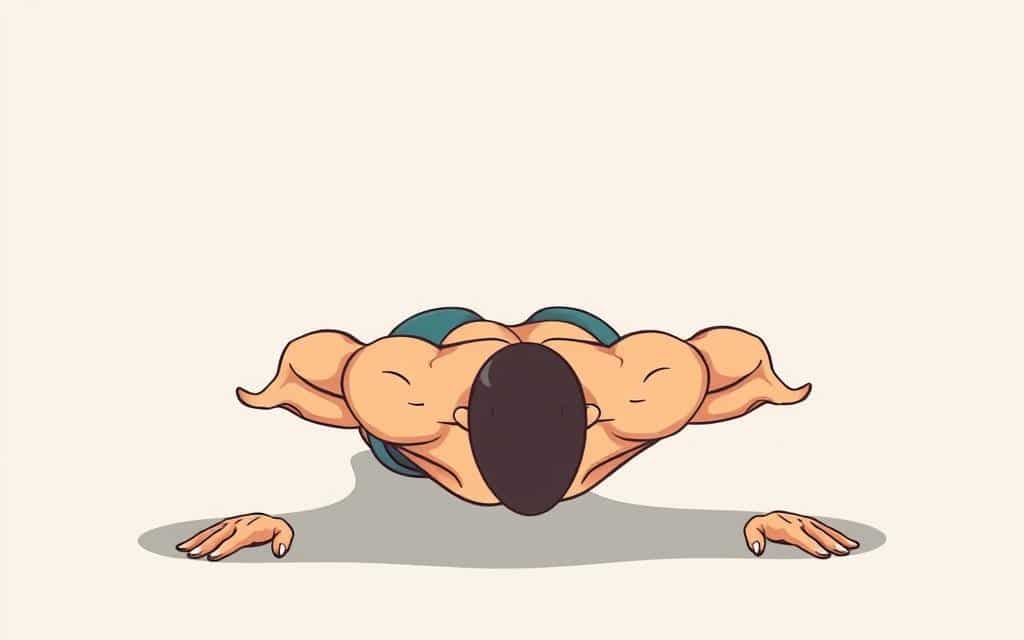
You can torch fat and build real strength with an upper body workout without equipment that fits your schedule and the space under your desk.
Picture a 20-minute AMRAP where pushups, dips, T-lifts, and planks make your chest, back, arms, and core burn in the best way — sweaty, focused, and efficient.
Research shows a 20-minute bodyweight AMRAP can outpace steady treadmill runs for training stimulus, and consistent pushup training can match moderate bench-press stress over weeks.
I’ll give you clear cues for hand, foot, and head position on the floor, safe warm-ups for shoulders and wrists, and progressions so you start where you are and level up fast.
Key Takeaways
- Short, intense sessions like 20-minute AMRAPs deliver big results when done right.
- Bodyweight moves can build strength and muscles, especially with smart progressions.
- Hand, feet, and head position matter—small tweaks protect joints and boost power.
- Pulling patterns may need a bar or bands later; start with pressing and core control now.
- Warm-ups for shoulders and wrists keep you training consistently and pain-free.
What you’ll achieve with an upper body workout without equipment
Train smarter: use simple bodyweight moves to build strength that matters for daily life.
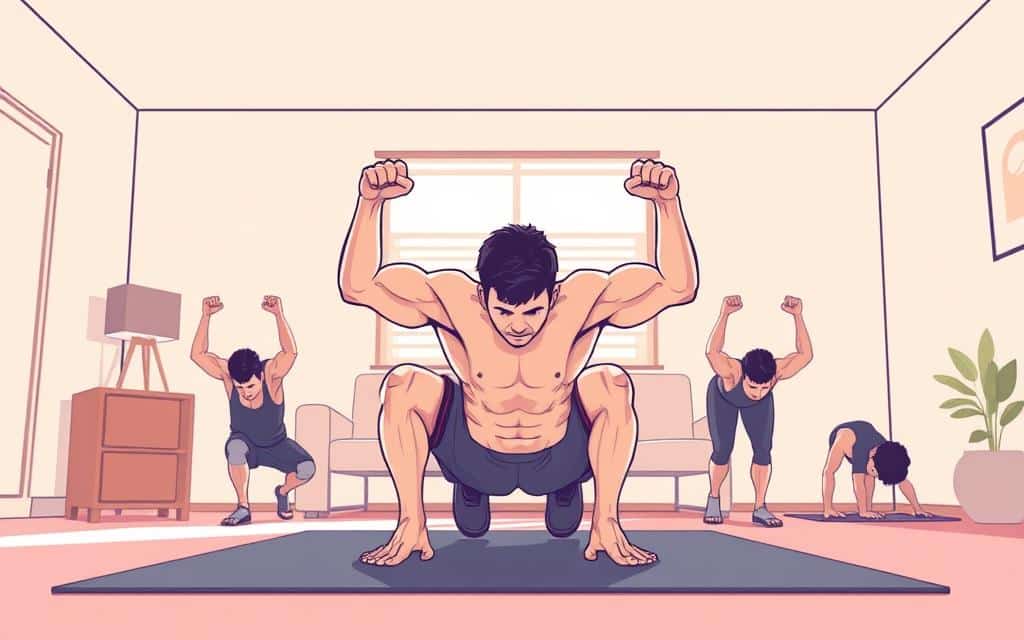
You’ll gain practical strength in your arms, chest, and back that shows up when you carry groceries, lift boxes, or push a stroller.
Men’s Health notes that this style of training boosts mobility and stability for all levels. Healthline highlights that arm function relies on the chest, shoulders, and upper back. So pushups, planks, and dips work—while pulling patterns need later progressions.
- Better shoulder control: hold cleaner positions in pushups and planks to protect joints.
- Core stability: ties your upper and lower body so your spine stays safer under load.
- Proprioception: awareness of your hands, feet, and knees for sharper mechanics.
- Consistency: you only need a few square feet to train, so you’ll stick with it.
| Benefit | Real-life task | Primary muscles | How it helps |
|---|---|---|---|
| Push strength | Pushing a stroller | Chest, shoulders, triceps | Improves force and endurance |
| Pull stability | Opening heavy doors | Upper back, lats | Boosts posture and balance |
| Core linking | Picking up kids or boxes | Abs, obliques, lower back | Protects spine and transfers power |
| Cardio conditioning | Hiking or climbing stairs | Full body, legs | Keeps heart rate up in short sessions |
Quick-start checklist: space, setup, and safe positions on the floor
Set a tiny training zone on your floor and nail the positions that keep your shoulders and wrists safe. Clear a non-slip rectangle so your feet won’t slide and your hands can plant shoulder-width apart with your arms straight.
Hand, wrist, and shoulder alignment
Stack your shoulders over your wrists. Spread your fingers and press gently through the palms to protect sensitive wrists. Keep your elbows softly unlocked and angled about 30–45 degrees from your sides so the shoulders track naturally.
Core and hips
Start each set in a clean starting position: neutral spine, ribs down, hips level, and head aligned with your body. Brace your core as if you’re about to cough — that locks the hips and prevents sagging or a piked plank position.
Place your feet hip-distance for stability. Narrow the stance to challenge balance later. If wrists bother you, elevate your hands on a sturdy book or make fists. Use knees bent regressions when needed, and when a set ends, return starting smoothly instead of collapsing.
| Setup item | Quick cue | When to change |
|---|---|---|
| Hands | Shoulder-width apart; fingers spread | Elevate if wrists hurt |
| Shoulders | Stack over wrists; shoulders relaxed | Reduce range if you feel pinching |
| Core & hips | Neutral spine; ribs down | Bend knees for regressions |
| Feet | Hip-distance for balance | Narrow to up the challenge |
Warm up in five minutes: priming shoulders, chest, and core
Get five minutes in and prime your shoulders, chest, and core so your sets feel cleaner and safer. Move steadily through six 30-second stations and touch each cue below.
Shoulder rolls and cactus arms to open the chest and lats
Shoulder rolls — keep your head neutral and make big, smooth circles. Don’t shrug; keep the motion through the front and top of the shoulder.
Cactus arms — pull elbows to 90 degrees in front, then open them back and forth. This wakes the lats and opens the chest without forcing range.
Inchworm walkouts and jumping jacks to raise body temperature
Jumping jacks: land softly on the floor with your feet slightly wider than hips. Reach overhead, then return starting position under control.
Inchworm walkouts: hinge from the hips, walk your hands to a strong plank, then walk them back and stand tall. Bend knees if hamstrings tug.
Downward Dog to plank and shoulder taps for stability
Downward Dog to plank — press the floor away through your palms, lift hips to the top, then glide forward into a steady plank without sagging.
Shoulder taps — from plank, tap the opposite shoulder with your right hand, then alternate. Keep feet planted and hips level to protect your lower body and keep the front chain engaged.
- Sequence: 6 moves × 30 seconds = five minutes total.
- Why it works: elevates body temperature, wakes up legs and lower body, and primes shoulders and core for the session.
Foundations of bodyweight strength: why it works for muscle and fitness
Simple moves using your mass can spark real gains in strength and muscle. You load the system by changing position, range, tempo, or total reps. That makes progress easy to manage and track.
Evidence snapshot: press-up training that simulates roughly 40% of a 1RM bench has produced similar muscle and strength gains over eight weeks. A separate study found a 20-minute AMRAP of bodyweight exercises gave a bigger training stimulus than steady treadmill running.
Why it works in practice
- Scalable load: tweak hand or foot position to make each exercise harder or easier.
- Stability demand: the floor and gravity force your shoulders and back stabilizers to work, so more muscles get involved.
- Mobility and durability: moving cleanly through full range improves joint health while you build muscle.
- Consistency wins: no setup means you can train anywhere and keep hitting progressive reps and sets.
| Study | Finding | Practical tip |
|---|---|---|
| Journal of Exercise Science & Fitness | Press-up ≈ 40% 1RM bench for strength gains | Use full range and steady volume for 8 weeks |
| Kennesaw State | 20-min AMRAP > treadmill for stimulus | Try timed circuits to boost conditioning |
Master the plank position: your base for pressing and core control
Nail a clean plank and you build a safe base for every pressing move and core test. The plank position teaches tension, alignment, and how your limbs link under load. Start with clear cues and pick the variation that fits your goals and joints.
High plank vs forearm plank: pick the right version
In a high plank, stack your shoulders over your hands. Press through the palms and screw your hands lightly into the floor to create stability for pressing and shoulder taps.
In a forearm plank, place elbows under the shoulders and keep forearms parallel or clasped. Drive the floor away so you don’t sink between the shoulder blades and lose tension.
- Choose high plank to prep for pushups and shoulder taps.
- Choose forearm plank if wrists are cranky or you want more core focus.
- Brace your core and tuck hips slightly so ribs don’t flare. If hips sag, bring feet closer or drop to knees to reset.
- Keep a long line from head to heels. Eyes on the floor—don’t crane your neck.
- Start each rep from a solid starting position. Reset if hands or elbows drift.
| Variation | Main cue | When to use |
|---|---|---|
| High plank | Shoulders over hands; press through palms | Prepping for pushups, shoulder taps, pressing work |
| Forearm plank | Elbows under shoulders; drive floor away | Wrist relief; deeper core challenge |
| Regression | Drop to knees; shorten lever | When form breaks or hips sag |
| Progression | Narrow feet, add shoulder taps, increase hold time | When you keep a rock-solid line |
Push strength without equipment: chest, shoulders, and triceps
Pressing strength doesn’t need a gym—just good form, solid cues, and steady progress. Focus on clean position and controlled tempo to build chest and arms safely.
Pushup variations
Standard pushup: place hands just wider than shoulder width, spread the palms, keep elbows ~45°, and lower your chest to the floor in a straight line.
If form breaks, use knees bent or elevate hands on a bench to own the pattern. For strength, try a pushup hold: lower halfway, pause 3–5 seconds, then press up for cleaner muscle tension and fewer fast reps.
Triceps dips and tabletop lifts
Chair triceps dips: fingers forward, chest up, elbows track back. Press through hands and keep shoulders down away from ears.
Tabletop lifts: squeeze glutes, press through feet and hands, lift hips to parallel. Pause at the top to challenge shoulder extension and the back of your arms.
Overhead adduction and wall angels
Hinge slightly at the front, reach arms straight overhead, then control the return to train shoulder patterning and posture. For mechanics, do wall angels: keep back and head on the wall and slide elbows while keeping contact.
| Move | Main cue | Regression |
|---|---|---|
| Standard pushup | Hands wider than shoulders; straight line | Knees bent or elevated hands |
| Pushup hold | Pause mid-range 3–5s; slow presses | Shorter hold time |
| Chair dips | Fingers forward; elbows back | Knees bent closer to chair |
| Tabletop lift / Wall angel | Hips parallel; arms straight; slide w/ control | Smaller range; fewer reps |
Posterior chain and back without gear: smart substitutes
No pull bar? No problem — these substitutes keep your back strong and balanced. You’ll use safe, floor-based moves that load the posterior chain and mid-back without heavy gear.
Locust lifts and Superman for spinal erectors and lats
Locust lifts: lie face down on the floor. Squeeze your glutes first, then lift chest and legs a few inches. Keep your head neutral to protect the spine.
Superman: reach long through fingertips and feet. Lift to the top briefly, then lower with control. Avoid hinging from the low back — move from the whole torso.
T-lifts to hit mid-back and rear delts
T-lifts: lay prone with arms out to the sides, thumbs up. Lift arms away from the floor while keeping ribs down. Focus on squeezing between the shoulder blades.
- Start each rep from a stable starting position and favor tension over height.
- Keep movements symmetrical on both sides; reduce range if one side lags.
- Add small pauses at the top to increase time under tension.
- Return starting position smoothly to keep rhythm and cut neck strain.
| Move | Main cue | When to use |
|---|---|---|
| Locust lift | Squeeze glutes first; head neutral | Spinal erector focus |
| Superman | Long reach; controlled lower | Lat and extensor work |
| T-lift | Thumbs up; ribs down | Mid-back and rear delt emphasis |
Core that supports your upper body: anti-rotation and bracing
A tight midline makes every press and hold feel easier and safer. This section gives crisp coaching for anti-rotation and clean lines using simple progressions.
Plank hold, plank jacks, and plank taps
Plank hold: brace your core, squeeze glutes, and keep hips level. If you sag, shorten the lever or reset to hold a stronger position.
Plank jacks: jump feet out and in while keeping shoulders quiet and hips steady. Land softly to maintain core tension.
Plank taps: widen your feet slightly and tap alternating shoulders with minimal torso shift to train anti-rotation through the midline and arms.
Prone V-ups and Downward Dog hold
Prone V-ups: walk feet toward hands to pike the hips without rounding your back, then walk feet back to reset. Move with control and tight bracing.
Downward Dog hold: press the floor away, lengthen the spine, and keep heels reaching toward the ground for shoulder and core endurance.
Progressions: slow tempo, add 1–3 second pauses, or narrow feet to boost the anti-rotation challenge. Breathe into your ribs while you brace; controlled breaths help you keep tension and resist unwanted motion at the hips and trunk.
| Move | Main cue | Progression |
|---|---|---|
| Plank hold | Brace core; hips level | Lengthen hold time |
| Plank taps | Minimal torso shift; shoulder tap | Narrow feet |
| Prone V-up / Dog hold | Pike hips; press floor away | Add slow reps or pauses |
Technique cues that prevent strain on wrists, elbows, and shoulders
Keep your joints safe by dialing in position and tension before you add reps. Small changes stop flare-ups and keep progress steady. Use these cues as your checklist each set.
- Protect your wrists: stack shoulders over your hands, spread fingers, and press evenly through the palm base. Don’t dump weight forward.
- Elbow tracking: keep elbows at about 30–45 degrees from your torso to reduce shoulder stress and keep force through the arms.
- Set the shoulders: gently pull shoulder blades down and back before you move, and hold that position as you bend and straighten.
- Head and gaze: keep your head neutral and eyes a few inches ahead on the floor so your neck stays aligned with your spine.
- Stabilize hips and knees: if knees buckle or hips sway, widen your stance a touch and brace your core to lock the whole chain.
- Modify hands if needed: elevate hands on a bench or use fists to ease wrist extension, then work back to flat hands as mobility improves.
- Listen to sharp pain: pause any move that hurts. Adjust range or position until motion is smooth and controlled.
- Prioritize form: build reps only while holding clean mechanics—form first, volume second.
| Cue | Why it helps | Quick fix |
|---|---|---|
| Shoulders over hands (position) | Aligns joints to bear load and protect the shoulder | Shift hands slightly forward or back until stacked |
| Elbows 30–45° | Reduces impingement and spreads load to triceps | Bring elbows closer to the ribs during descent |
| Neutral head & gaze | Prevents neck strain and keeps the spine long | Look a few inches ahead on the floor |
| Core brace & hip position | Stabilizes the chain so shoulders and arms work efficiently | Tighten abs, squeeze glutes, and check hip level |
Apply these cues every time you train. They keep the floor as your tool and let bodyweight moves build strength without nagging aches. Stay consistent, stay smart, and you’ll level up safely.
upper body workout without equipment: a 20-minute AMRAP you can do today
Set your timer for 20 minutes and move with intent. Use 45 seconds work and 10 seconds rest per station. Aim for steady reps and clean position over all-out speed.
Structure: work intervals, rest windows, and how to pace
Pick a rhythm you could keep for two more minutes at the end—that pace wins total volume.
- Set timer: 20 minutes total — 45s work / 10s rest.
- Move station to station; start each rep from a solid starting position and keep your head neutral.
- After each station, return starting smoothly—no flopping—to save energy and joints.
Round-by-round moves (ready-to-run)
| Block | Moves (repeat twice) | Key cue |
|---|---|---|
| Block 1 | T-lifts, Bear-to-Plank, Triceps Dips, Prone V-ups | Start each rep from starting position; keep head neutral |
| Block 2 | Tabletop Lifts, Plank Jacks, Pushup Hold, Overhead Adduction | Keep hands steady or overhead; hips level |
| Block 3 | Plank Hold, Locust Lifts, Downward Dog Hold | Quality tension from head to feet; hold plank position clean |
Extra cues: on Bear-to-Plank, land feet softly under the hips then step back to plank without dropping. If you add shoulder taps, tap with your right hand then the left with minimal sway; widen stance if your sides rock.
Pacing tip: choose a steady tempo for consistent reps. Return starting position smoothly between stations and focus on controlled bodyweight exercises that stack wins over time.
Strength-focused routine: sets, reps, and tempo for muscle
Want visible gains? Use deliberate pauses and slow lowers to make each rep count. Structure your session so quality beats quantity. That means clear sets, planned tempo, and simple rules for when to progress.
Time-under-tension: pauses, slow lowers, and full range
Use 3–5 sets of 6–15 reps for your main pushing move (standard pushups or pushup hold clusters). Stop 1–2 reps shy of failure so form stays crisp and productive.
Add tempo: lower for 3–4 seconds, hold 1–2 seconds at the bottom or top, then press with a smooth acceleration. That time strategy forces the muscle to work without added gear.
- Pair patterns: do a chest move then a back move (pushups + T-lifts or pushups + Locust lifts) to keep shoulders balanced.
- Core work between sets: hold a plank or hollow for 20–30 seconds to lock the midline and boost pressing stability.
- Progression rule: when you hit all sets and reps with clean range, increase tempo difficulty or trim rest.
| Focus | Protocol | Why it works |
|---|---|---|
| Primary push | 3–5 sets × 6–15 reps; 1–2 reps shy of failure | Builds strength and muscle with controlled volume |
| Tempo | 3–4s down; 1–2s pause; controlled up | Increases time under tension without external load |
| Core | Plank 20–30s between sets | Improves pressing stability and trunk control |
Keep feet placement consistent so you can gauge progress. Rotate hand positions week-to-week (narrow, standard) to vary stimulus while protecting the shoulders. Track session time and stay deliberate—strength blocks should feel controlled, not rushed.
Progressions and regressions: scale every exercise your way
Small, steady changes in position and tempo are the fastest route to better reps. Pick a clear starting point, own the motion, and add one challenge at a time. Below are simple paths so you can self-select the right level and move up confidently.
From knees bent to full pushups to pushup hold
Start with hands elevated or knees bent until you can do clean repetitions. Focus on a tight starting position and a straight line from head to knees or heels.
- Step 1: Elevated hands — feel the press pattern and lock the core.
- Step 2: Knees bent — press with control, full range as form allows.
- Step 3: Full pushups — aim for steady sets of clean reps.
- Step 4: Pushup hold — lower halfway, pause 2–4s, then press up to build tension.
From basic plank to shoulder taps to star plank
Begin with a solid plank and a wide base for stability. Progress when your hips stay still and your shoulders feel steady.
- Basic hold: brace core and keep hips level.
- Shoulder taps: tap with your right hand then alternate; widen feet if you rotate.
- Star plank: walk hands and feet outward for max tension once taps are stable.
| Path | Beginner | Intermediate | Advanced |
|---|---|---|---|
| Push pattern | Hands elevated | Knees bent → full pushups | Pushup holds (mid-range pauses) |
| Plank pattern | Wide-base plank | Plank → shoulder taps | Star plank / narrow lever |
| Progress rule | Own form for 3 sets | Add tempo or reps | Increase range or slow eccentrics |
| Quick cue | Tight starting position | Log reps and note form break | Return starting position and rest |
Practical tips: change only one variable — range, tempo, or position — per session. If shoulder taps create rotation, widen your stance and think “quiet hips” while tapping. Between sets, return starting position, shake out your hands and shoulders briefly, then go again.
Want a curated list of moves to pair with these progressions? Check the top bodyweight exercises for proven options you can slot into any path.
Weekly plan and recovery: how many days, what order, how to rest
Plan a realistic weekly routine so training fits your life, not the other way around. Aim for consistency first, then increase volume or intensity.
A practical 3–4 day approach: two sessions focused on upper body strength, one session for lower body or total-body work, and one optional cross-training day. Keep at least one full rest day to recover and reset.
Scheduling with active recovery and cross-training
Example routine: Monday — upper body; Wednesday — lower body or total-body; Friday — upper body; Saturday — cross-training or cardio. Take Sunday off or use it for an easy mobility flow.
- Keep sessions short and focused: 20–30 minutes of intentional training.
- Program leg and feet work on non-consecutive days so your legs recover from jumps or squats in warmups.
- Rotate focus each session: push strength day, posterior chain day, core stability day to hit different muscles without overuse.
- Use light mobility flows on off days to keep shoulders and hips loose.
| Days per week | Focus | Tip |
|---|---|---|
| 3–4 | Two upper, one lower/total, one cross-train | Short sessions; rest at least one full day |
| Recovery | Active or full rest days | Mobility and sleep count as training |
| Tracking | One metric weekly | Total reps, hold time, or progression |
Stress rule: if life is busy, cut volume by ~20% and keep technique strict. Small, smart changes beat missed sessions and keep strength gains steady.
Common mistakes that stall strength and how to fix them
Tiny mistakes in position add up — here’s how to stop them from stealing gains. Fix these faults fast and you’ll keep building strength without extra sets.
- Sagging back: tighten your core, tuck hips slightly, and push the floor away. Aim for one long line from head to heels.
- Flaring elbows: keep elbows ~45°; think “armpits forward” to protect shoulders and keep pressing efficient.
- Dropped head: pick a spot a few inches ahead on the floor and lengthen through the crown to keep your head neutral.
- Collapsing knees: place your feet hip-distance, squeeze glutes to lock the hips, or bend knees and shorten the lever if needed.
- Rushed reps: slow the descent to three seconds and add a short pause at the bottom to build strength rather than just finishing exercises.
- Uneven hands/load: set your hand placement before each set and check shoulder level to avoid twisting through the hips.
- Hips rocking on taps: widen stance, brace harder, and move the hand slower so your torso stays square.
- Pain vs. effort: sharp joint pain = stop and adjust; effort discomfort is normal — learn the difference and train smart.
| Mistake | Main cue | Quick fix | When to regress |
|---|---|---|---|
| Sagging back | Brace core; tuck hips | Push floor away; check line head→heels | Drop to knees or shorten lever |
| Flaring elbows | Elbows ~45°; armpits forward | Bring elbows closer during descent | Elevate hands or reduce range |
| Collapsed knees or unstable feet | Feet hip-distance; squeeze glutes | Bend knees and shorten lever for stability | Use knee regressions until stable |
| Hips rocking / uneven load | Brace core; slow the hand movement | Widen stance; reset hand placement | Return to static holds before dynamic taps |
Rule of thumb: fix one variable at a time — position, tempo, or range. Clean mechanics beat extra reps every time.
Limited by space or time? Micro-sessions that still build muscle
Short blasts of focused movement can outsmart a long session and still grow real strength. Use tight structure and clear cues to get the most from minimal time and room.
Ten-minute EMOM and ladder mini sessions
Try these plug-and-play plans on busy days. Each is scalable and keeps your position and form first.
- 10-minute EMOM: Minute 1 — pushups (quality reps). Minute 2 — plank hold (40 seconds). Repeat 5 rounds. Stop 1–2 reps shy of failure and keep position pristine.
- Ladder set (6–10 minutes): 2-4-6-8-10 pushups paired with T-lifts for 6–10 controlled raises each rung. Rest on the floor only as needed.
- Core finisher (5 minutes): 30s Downward Dog hold into 30s plank jacks, repeat to spike heart rate and midline control.
If space is tiny, favor static holds (pushup holds, wall angels) and slow eccentrics to load muscle with limited movement. Keep legs and lower body engaged across sessions with short squat or glute bridge ladders on alternate days.
| Mini plan | Duration | Main cue |
|---|---|---|
| 10-min EMOM | 10 min | Quality reps; timer strict |
| Ladder | 6–10 min | Controlled reps; minimal rest |
| Core finisher | 5 min | Stable floor contact; tight core |
Track total reps each session and try to beat it by a couple of clean reps next time. Use a timer and prioritize pain-free work—clean quality wins over sloppy volume every time.
When bodyweight isn’t enough: pull patterns and simple add-ons
Biceps and lats need direct pulling to keep your shoulders balanced and your arms healthy. Most push-heavy plans miss that. Healthline notes it’s hard to load the back and biceps properly with only floor-based moves.
Why pulling matters and how to bridge the gap
Push presses and planks build the front chain, but true vertical and horizontal pulls target the back and elbow health.
Without pulls, posture and joint balance suffer. Men’s Health highlights wide-grip pull-ups and ring work as top bodyweight pulling methods for complete development.
Low-cost options: doorway bars, rings, and bands
- Doorway bar: lets you do pull-ups, chin-ups, and isometric hangs. Test the fit—start with slow hangs, then partial reps.
- Rings: add instability that challenges your hands and shoulder stabilizers in a useful way.
- Resistance bands: the easiest, cheapest way to make rows, pulldowns, and face pulls anywhere. Begin with band rows at chest height; keep elbows close and pull to the ribs to protect joints.
| Tool | Best for | Key cue | Cost / Portability |
|---|---|---|---|
| Doorway bar | Pull-ups, hangs, chin-ups | Slow hangs first; build partial reps | Low–moderate / stays at door |
| Rings | Rowing variants, ring pull patterns | Control instability; focus on scapular squeeze | Moderate / portable |
| Resistance bands | Rows, pulldowns, face pulls | Chest-height rows; elbows tight to ribs | Low / highly portable |
Programming tip: alternate push and pull days so your back and arms get even attention. These small tools are the simplest way to unlock complete upper training and steady long-term progress.
Conclusion
Make two simple promises this week: show up twice and move with intent. The 20-minute AMRAP model works — it delivers real stimulus in little time and helps you build chest and pressing strength that tracks with more traditional lifts.
Use the warm-up and drilled position cues to protect joints. Keep your palms planted, hold a steady plank as your base, and prioritize clean reps. These bodyweight exercises are a practical way to get fit and add muscle without complex gear.
When you’re ready, add a doorway bar or resistance bands to bring pulling into the mix. Schedule two sessions, set a timer, and follow the plan. Small, consistent steps compound into real fitness progress you can feel in daily life.